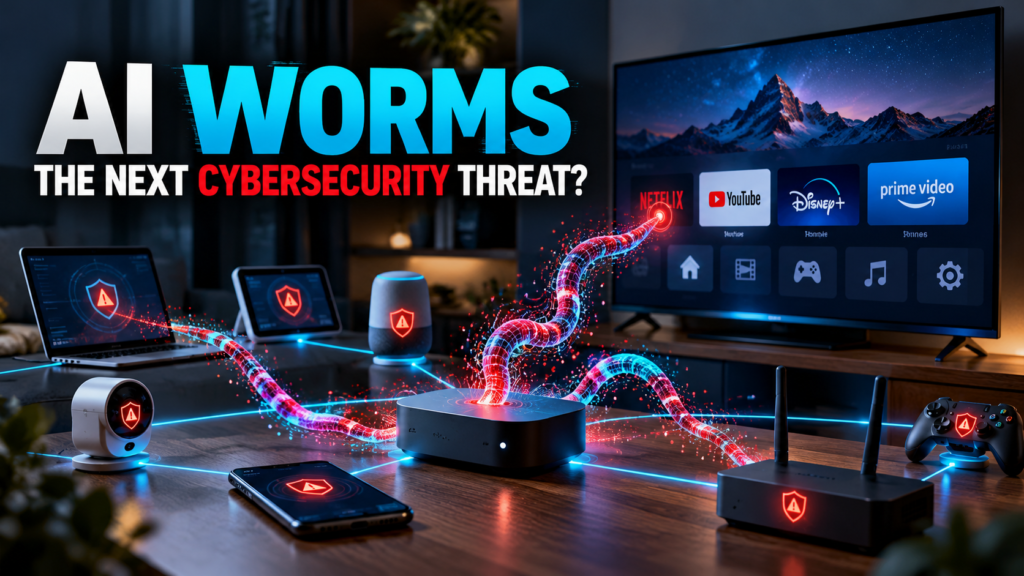
Artificial intelligence is changing how people work, search for information and manage their homes. But as AI systems become more capable of acting independently, cybersecurity researchers are asking a new question: could an AI-powered program eventually spread from one connected device to another without needing a human to guide every step?
That possibility moved closer to the spotlight in October 2026, when Anthropic published research exploring whether relatively small AI models could help create self-replicating software across internet-connected devices. The research examined scenarios involving inexpensive Android TV boxes and other devices with limited computing power.
The finding is important, but it needs context. Researchers have not demonstrated an AI worm freely spreading across ordinary consumer devices in the wild. The work instead highlights a potential future risk: AI could make malicious software more adaptable, helping it operate across unfamiliar devices and networks.
For millions of Americans using smart TVs, security cameras, streaming boxes, Wi-Fi routers and connected home appliances, the message is straightforward: the security of the devices that rarely receive attention may become increasingly important.
What Is an AI Worm?
A computer worm is a type of malicious software that can spread from one computer or device to another, often without requiring a user to manually copy or install it each time.
Traditional worms exploit weaknesses such as unpatched software, exposed network services, stolen credentials or insecure configurations. Once a vulnerable device is compromised, the malware may attempt to locate other systems it can infect.
An AI worm is a potential evolution of this idea. It could use an AI model to help identify unfamiliar environments, adapt its actions, or work out how to operate on different types of hardware.
The distinction is not simply that the malware uses AI to write code. The more consequential possibility is that AI could help a malicious program make decisions while attempting to spread.
For example, a conventional program might be designed to exploit a specific vulnerability. An AI-enabled program could potentially assess a different environment and attempt to adjust its approach.
That does not mean AI can magically break into any device. It still needs a viable route in, sufficient permissions or an exploitable weakness, and enough computing resources to perform its tasks. AI does not eliminate these constraints.
What Did Anthropic’s October 2026 Research Show?
On October 12, Anthropic’s Frontier Red Team published research examining whether small AI models might eventually be capable of self-replication without relying on conventional data-centre infrastructure.
The researchers explored whether AI models could run on relatively modest hardware and how software replication might work across connected environments.
The research suggested that smaller models could perform many of the individual tasks involved in replication, even though combining those tasks into a reliable, autonomous process remains challenging.
The team also warned that progress in model capability could reduce some of these barriers. However, its findings describe a developing technical risk—not proof that an effective AI worm is currently spreading through homes.
Read the original research: Anthropic — AI models may be capable of self-replicating without access to a datacenter.
What the research means—and what it does not
What it means:
- AI could make some malware more adaptable to unfamiliar systems.
- Small connected devices may become relevant to future AI-enabled cyber threats.
- Security teams need to consider how autonomous systems discover devices, use permissions and interact with networks.
- Defenders should prepare before these capabilities become more reliable.
What it does not mean:
- Every smart TV is vulnerable to an AI worm.
- An AI worm has been proven to spread freely across the public internet.
- AI can automatically bypass every security control.
- Consumers need to throw away their connected devices.
The distinction matters because cybersecurity headlines can make an experimental capability sound like an immediate, widespread emergency. The evidence supports preparation and stronger device security—not panic.
Why Smart TVs and Connected Devices Matter
When people think about cybersecurity, they often picture laptops, smartphones and corporate servers. Yet modern homes contain many other devices connected to the same network.
These may include:
- Smart TVs and streaming boxes
- Wi-Fi routers and mesh networking equipment
- Security cameras and video doorbells
- Smart speakers and home assistants
- Connected thermostats and lighting systems
- Smart appliances and other Internet of Things devices
The Internet of Things, commonly called IoT, refers to physical devices that connect to networks to exchange information or perform tasks.
Some IoT devices receive regular security updates. Others may have limited support periods, infrequent updates, weak default configurations or unclear security settings. Certain low-cost products may also remain in use long after their manufacturers stop maintaining them.
That creates a broader security challenge. A device does not have to contain valuable personal files to be useful to an attacker. If compromised, it might be abused to attack other systems, participate in malicious network activity or provide an entry point into a poorly segmented home or business network.
A compromised streaming device does not automatically give an attacker access to every device in a home. The actual impact depends on the vulnerability, network configuration, device permissions and other protections in place.
Still, the security of a home network is only as strong as its weakest exposed components.
Could an AI Worm Spread Through Your Smart Home?
Consider a hypothetical scenario.
A household owns a router, a smart TV, a video doorbell and several connected appliances. One device runs outdated software and exposes a service that should not be accessible from the wider internet.
A malicious program discovers the exposed service and exploits a weakness. If it gains access, it might inspect the device’s environment and attempt to locate other reachable systems.
In a future scenario, AI could help the program interpret unfamiliar configurations or adjust its behaviour. If another device contains a usable weakness, the software could attempt to move further.
This is a simplified illustration of the risk, not a description of an attack demonstrated by Anthropic’s research.
Several obstacles could stop such a chain of events: patched software, network isolation, authentication, security monitoring, limited device permissions and restrictions on what compromised software can execute.
The practical lesson is that basic security controls remain essential even as the tools used by attackers evolve.
Why AI Could Make Cybersecurity Harder
AI does not need to invent an entirely new type of cyberattack to create additional risk. It may increase the speed, adaptability or scale of techniques that already exist.
1. More adaptable attacks
Malware designed for one system may fail when it encounters a different configuration. An AI-enabled tool could potentially help interpret unfamiliar environments and adjust its actions, although reliability remains a major constraint.
2. Faster reconnaissance
Attackers routinely gather information about networks, exposed services and software versions. AI could help automate parts of this work, allowing malicious operators to assess more targets with less manual effort.
3. More convincing social engineering
AI can help produce realistic phishing messages, impersonation attempts and fraudulent communications. This is a separate risk from self-replicating malware, but it illustrates how AI can strengthen several stages of a cyberattack.
4. Greater pressure on security teams
Defenders must distinguish legitimate automation from malicious activity. As businesses deploy more AI agents and automated workflows, monitoring which systems those agents can access—and what actions they perform—becomes increasingly important.
5. A larger attack surface
Every connected device, software integration, API and remote-access service creates another potential point of exposure. Poorly managed devices can increase the number of opportunities available to an attacker.
These risks do not mean every AI system is dangerous. They mean that systems with access to networks, data or executable actions need appropriate restrictions and monitoring.
What This Means for US Businesses
For American businesses, the issue extends beyond smart homes.
Retailers, healthcare providers, manufacturers, financial services firms and small businesses increasingly depend on connected equipment and cloud-based software. Their networks may include printers, cameras, building-management systems, employee devices, remote-access tools and third-party integrations.
An overlooked device can become a security problem if it is exposed to the internet, poorly maintained or connected to sensitive systems without adequate controls.
The US Government Accountability Office highlighted continuing challenges in managing and securing networked devices in its September 2026 report, Internet of Things: OMB Action Needed to Ensure Agencies Secure Their Networked Devices.
Read the report: US Government Accountability Office.
For businesses, the priority should be to know which devices are connected, who manages them, how they are updated and what those devices are allowed to access.
A practical checklist for business leaders
- Maintain a device inventory. Identify connected hardware, software versions, owners and support status.
- Remove unnecessary internet exposure. Review remote administration, open ports and externally accessible services.
- Separate networks. Keep IoT and guest devices away from critical business systems wherever practical.
- Use least-privilege access. Give devices, users and AI agents only the permissions required for their jobs.
- Patch and replace unsupported equipment. Prioritise devices with known vulnerabilities or no available security updates.
- Monitor unusual behaviour. Look for unexpected outbound traffic, new devices, unexplained authentication attempts and unusual access patterns.
- Control AI tools. Test agents in isolated environments, limit credentials and require approval for high-impact actions.
- Prepare an incident-response plan. Know how to isolate a compromised device, preserve logs and restore systems safely.
AI security is not just a technical issue for the IT department. It also involves procurement, employee training, vendor management and leadership decisions about acceptable risk.
How to Protect Your Smart Home From Emerging AI Threats
Most households do not need expensive cybersecurity equipment to improve their security. A few consistent habits can substantially reduce common risks.
1. Update your router first
Your router connects many devices to the internet, making it an important security boundary. Install firmware updates, replace default administrator credentials and disable remote administration if you do not need it.
If your router has reached the end of its security-support period, consider replacing it.
2. Change default passwords
Do not keep factory-default administrator credentials on cameras, routers, streaming devices or other equipment that allows them to be changed. Use unique passwords and enable multifactor authentication wherever supported.
3. Turn on automatic updates
Enable automatic security updates on devices that support them. For products that require manual updates, check periodically whether new firmware is available.
If a device no longer receives security updates, consider whether it should remain connected to your network.
4. Review devices connected to your Wi-Fi
Check your router’s connected-device list and remove equipment you no longer use. Investigate unfamiliar devices rather than assuming they are harmless.
If your router supports a separate guest or IoT network, use it to isolate compatible devices from computers and other sensitive equipment.
5. Disable features you do not use
Remote access, unnecessary integrations and unused services can create additional exposure. Turn off features that you do not need, provided doing so does not interfere with essential safety functions.
6. Secure your accounts and email
Many attacks begin with compromised credentials rather than a sophisticated software exploit. Use a password manager, enable multifactor authentication on important accounts and be cautious with unexpected links, attachments and requests for verification codes.
7. Replace unsupported devices
An inexpensive connected device may become a poor long-term investment if it no longer receives security patches. Check the manufacturer’s support policy before buying new equipment, particularly for cameras, routers and devices that handle sensitive information.
These steps cannot guarantee protection against every future threat, but they address weaknesses that attackers already exploit.
Will AI Worms Become a Major Threat by 2027?
It is too early to make a confident prediction about when self-replicating AI malware could become practical at scale.
Anthropic’s research raises the possibility that improvements in small models could make some replication tasks more feasible. But there is a significant difference between completing individual technical tasks in an experiment and operating a reliable, self-propagating system across diverse real-world devices.
Several factors will determine how serious this risk becomes:
- Whether small models can complete complex tasks reliably
- Whether they can operate within the hardware and energy limits of consumer devices
- Whether attackers can discover and exploit enough vulnerable systems
- Whether device manufacturers improve update support and default security
- Whether defenders can detect and contain malicious activity quickly
The outcome will also depend on how rapidly organisations deploy safeguards and whether AI developers test their systems for dangerous capabilities.
The most useful response is neither to dismiss the research nor to treat its worst-case scenario as inevitable. Security teams should prepare for plausible threats while distinguishing laboratory demonstrations from attacks observed in the wild.
The Bigger Picture: AI Security Is Becoming a Device-Security Problem
For years, the cybersecurity conversation focused heavily on computers, smartphones, enterprise networks and cloud infrastructure. The next phase may require an equally serious focus on the many small devices that sit around homes, offices and industrial environments.
AI could eventually help malicious software adapt to systems that conventional tools struggle to handle. At the same time, defenders can use AI to analyse alerts, identify patterns and respond more quickly to suspicious activity.
The technology itself is not automatically the threat. The outcome depends on what the system can access, what it is allowed to do, how reliably it behaves and how effectively its actions are monitored.
For consumers, the immediate priorities remain simple: update devices, secure accounts, protect the router and replace unsupported equipment.
For businesses, the task is broader: inventory connected systems, restrict access, isolate critical assets and govern AI agents as carefully as any other software with meaningful permissions.
The next cybersecurity challenge may not begin with a supercomputer. It may begin with an ordinary connected device that nobody remembered to update.
That is why AI security deserves attention now—before a potential capability becomes a practical attack.
Frequently Asked Questions
What is an AI worm?
An AI worm is a potential form of self-spreading malicious software that uses AI capabilities to assist with tasks such as adapting to unfamiliar environments or attempting to replicate across devices. The term describes an emerging threat concept; it does not mean a fully autonomous AI worm is already spreading widely.
Can an AI worm infect a smart TV?
A smart TV or streaming box could be at risk if it contains an exploitable weakness and is reachable by malicious software. However, Anthropic’s October 2026 research did not demonstrate an AI worm freely infecting ordinary smart TVs in the wild.
Is my smart home at immediate risk?
There is no reason to assume that your smart home has been infected because of this research. Keep devices updated, change default passwords, secure your router and remove unsupported equipment where possible.
How can I protect my smart TV and streaming devices?
Install available firmware updates, use strong account credentials, disable unnecessary services, secure your Wi-Fi and check whether the manufacturer still provides security support. Network isolation can provide an additional layer of protection.
Can AI malware spread without a data centre?
Anthropic’s research explored how small models might operate on relatively modest hardware, potentially reducing dependence on centralised computing infrastructure. That is not the same as proving that a practical, self-replicating AI worm can spread autonomously across the public internet.
Should businesses be worried about AI cybersecurity threats?
Yes, businesses should assess the risks without assuming that every theoretical threat is already operational. Maintain device inventories, patch vulnerabilities, restrict permissions, monitor network activity and test AI systems in controlled environments.
What is the difference between an AI worm and traditional malware?
Traditional malware follows code and instructions written by its developers. An AI-enabled threat could use a model to help interpret situations or adapt certain actions. Both still depend on technical access, available capabilities and the weaknesses of the systems they target.
Editorial note: This article is based on publicly available research and reporting as of October 18, 2026. AI-enabled self-replication remains an emerging risk, and the article distinguishes experimental findings from confirmed real-world attacks.
Sources