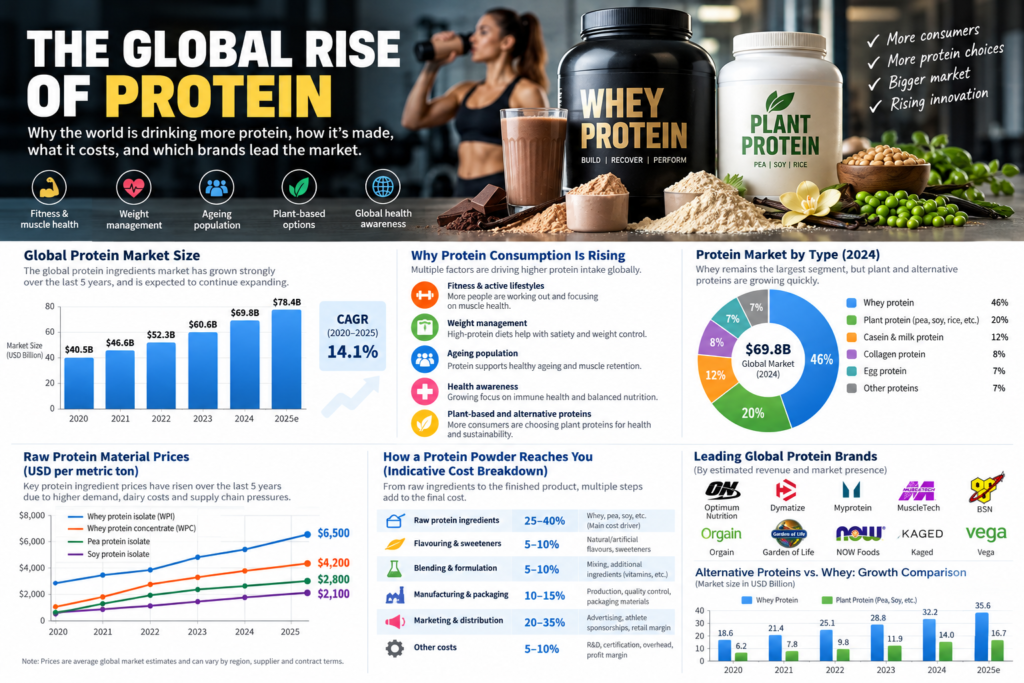
Introduction: How Protein Became a Global Business
Walk into a supermarket, browse an online grocery store or visit a fitness retailer, and protein is increasingly difficult to miss.
It appears in traditional whey protein powders, ready-to-drink shakes, high-protein yoghurts, snack bars, breakfast cereals and even products that historically had little connection with sports nutrition.
What began as a specialist category associated with bodybuilders has expanded into a broader consumer market serving gym-goers, recreational athletes, people managing their weight and consumers interested in healthy ageing.
This shift is creating opportunities for ingredient manufacturers, supplement brands, food companies, retailers and contract manufacturers.
But the protein boom has a more complicated business story behind it. Consumer demand is expanding, yet raw-material prices can fluctuate sharply. Formulators must balance protein concentration with taste and texture. Brands must pay for testing, packaging, distribution and marketing. Meanwhile, plant-based alternatives are competing with whey for customers who want different ingredients or dietary options.
The central question is no longer simply whether people want more protein. It is which companies can supply it affordably, consistently and in a form consumers want to buy repeatedly.
1. How Big Is the Global Protein Supplements Market?
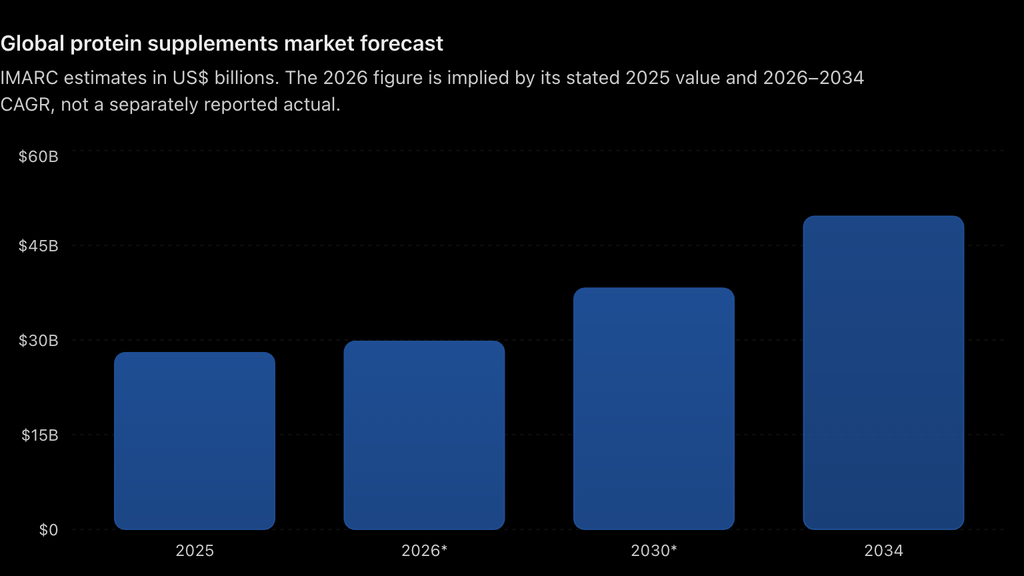
According to IMARC Group, the global protein supplements market was valued at approximately $28 billion in 2025. The firm forecasts that it will reach $49.6 billion by 2034, implying annual compound growth of approximately 6.4% from 2026 to 2034.
These figures cover protein supplements, rather than every food containing protein. Other research firms publish different estimates because they classify products, regions and revenue streams differently.
For example, protein powders, ready-to-drink shakes, protein bars and specialized nutritional products may be grouped differently across studies. Consequently, the figures should be used as market estimates rather than as an official count of global protein consumption.
What is driving the growth?
Several forces are working together.
Fitness and sports nutrition: More consumers are interested in strength training, recovery and muscle maintenance. Protein supplements offer a convenient way to add protein to a diet.
Convenience: Ready-to-drink shakes, single-serving sachets and protein snacks allow consumers to purchase protein without preparing a full meal.
Weight management: Protein is frequently marketed for satiety and muscle maintenance. The rise of weight-management medications has also prompted food companies to pay closer attention to protein intake, although the effect on supplement sales varies.
Healthy ageing: Maintaining muscle becomes an increasingly important concern with age, creating demand for convenient protein sources among older consumers.
E-commerce and social media: Online retailers offer a wide choice of products, while fitness creators and influencers introduce new brands and formats to consumers.
Mainstream food innovation: Protein is moving beyond supplement tubs into everyday food and drink, expanding the number of occasions on which consumers encounter it.
The important distinction is that a growing supplements market does not necessarily mean the world’s total protein consumption is increasing at the same rate. People also obtain protein from meat, fish, eggs, dairy, beans, lentils, grains and other ordinary foods.
2. Five Years of Growth: Animal-Based vs Plant-Based Protein Supplements
The following chart uses a historical dataset published by Wantstats for the global protein supplements market by source. The figures are estimates from that research series, not audited sales reported by every manufacturer.
Five Years of Growth: Animal-Based vs Plant-Based Protein Supplements
The global protein supplements market includes both animal-based and plant-based products. Animal-based supplements include whey and other dairy or animal-derived proteins, while plant-based supplements include ingredients such as pea, soy and rice protein.
The following estimates illustrate the growth reported by one market-research dataset. They should not be treated as audited sales figures, and definitions may differ from other industry reports.
Estimated Global Protein Supplements Market by Source (2020–2025)
| Year | Animal-based protein | Plant-based protein |
|---|---|---|
| 2020 | $11.15 billion | $5.12 billion |
| 2021 | $11.96 billion | $5.54 billion |
| 2022 | $12.82 billion | $5.99 billion |
| 2023 | $13.74 billion | $6.48 billion |
| 2024 | $14.72 billion | $7.01 billion |
| 2025 | $15.78 billion | $7.58 billion |
Source: Wantstats market estimates. Figures are estimates, not audited industry-wide sales.
What does the data tell us?
The estimates show growth in both categories over the period. Animal-based protein remains the larger segment, while plant-based protein is becoming a more significant part of the market.
However, these figures represent estimated market value, not kilograms of protein consumed. They also cover broader categories than whey and pea protein alone.
The series suggests that both categories expanded between 2020 and 2025, with plant-based supplements growing from a smaller base.
However, this is not a direct measurement of how much whey protein was consumed globally. The animal-based category includes more than whey, while the plant-based category includes multiple sources such as soy, pea and rice. Market value also differs from kilograms of protein consumed.
The takeaway is that alternative proteins are gaining commercial importance without eliminating the much larger established animal-based segment.
3. Why Has Protein Become So Popular?
The growth is not being driven by one type of consumer.
The traditional fitness customer
For decades, whey protein has been closely associated with bodybuilding and strength training. It is popular because it is a concentrated source of protein, generally contains all essential amino acids and is convenient to consume after exercise.
The everyday wellness customer
Consumers who do not identify as athletes are also purchasing protein-enriched products. They may want convenient breakfasts, snacks or drinks that contribute to their daily protein intake.
The ageing consumer
Protein products are increasingly marketed towards people who want to maintain muscle as they age. This segment values convenience and tolerability, although individual nutritional needs vary.
The weight-management customer
Protein is often included in products designed to help people feel satisfied while managing their diet. The commercial opportunity extends to shakes, bars, meal-replacement products and fortified foods.
These groups overlap, but their preferences are not identical. A competitive bodybuilder may prioritize protein concentration and cost per serving, while a casual consumer may care more about taste, portability and ease of preparation.
That difference matters for manufacturers because a single formula rarely meets every customer’s needs.
4. Why Whey Protein Is So Important
Whey is a dairy-derived ingredient obtained during cheese and other dairy processing.
It can be processed into different protein ingredients, including whey protein concentrate and whey protein isolate.
Whey protein concentrate (WPC) retains varying amounts of protein, lactose, fat and minerals depending on the grade. Higher-protein grades generally contain a greater proportion of protein.
Whey protein isolate (WPI) undergoes additional processing to produce a higher protein concentration, usually with less lactose and fat than concentrate.
The extra processing and concentration can make isolate more expensive.
Whey remains commercially important because it combines several useful characteristics:
- A complete essential-amino-acid profile.
- A relatively high leucine content.
- Good suitability for many sports-nutrition formulations.
- Established supply chains and manufacturing expertise.
- Familiarity among fitness consumers.
- Versatility across powders, bars and beverages.
It is not automatically the best choice for everyone. People with dairy allergies need to avoid milk proteins, and those with lactose intolerance may need to consider the particular product and their own tolerance. Plant-based products can be appropriate alternatives depending on their formulation and nutritional profile.
5. Why Have Raw Whey Protein Prices Risen?
Protein powder prices are closely connected to the economics of dairy processing.
Whey is a by-product of cheesemaking, but converting it into a high-protein ingredient requires collection, processing, filtration, concentration, drying and quality control.
As demand for protein-enriched foods and supplements increases, manufacturers compete for suitable dairy ingredients. Supply cannot always expand immediately because production depends on milk availability, cheese output, processing capacity, energy costs and investment in specialized facilities.
The Financial Times reported in October 2026 that dairy companies were investing heavily in whey processing as the ingredient became more valuable, while growing consumer demand contributed to price pressure. <Cite refs={[“turn340807news60”]} />
The difference between raw material and retail price
A protein brand does not buy the same product that a customer sees on a store shelf.
Its input might be a bulk ingredient such as WPC80 or WPI90. The finished product then requires formulation, flavouring, blending, packaging, testing, transport and retail distribution.
The prices of these stages can move differently.
For example, a whey ingredient price increase may force a manufacturer to renegotiate supplier contracts or absorb a temporary reduction in margin. A brand may then increase its retail price, change pack sizes, adjust promotions or reformulate its products.
The timing depends on inventory, contracts, competition and the brand’s pricing strategy.
A note on raw protein prices
There is no single global spot price for all whey protein. WPC and WPI have different specifications, and quotations vary by origin, purity, order size, contract length, freight and currency.
A useful source for tracking dairy ingredients is Dairy for Global Nutrition’s dairy price and supply trends, which provides quarterly data for several dairy ingredients, including whey protein concentrate and isolate.
For this reason, a single global price-per-kilogram chart that combines different whey grades or compares them directly with unstandardized pea-protein quotes would be misleading.
6. What Does It Cost to Make a Tub of Protein Powder?
The retail price of protein powder is the end of a long supply chain.
A finished product may include the following cost components:
- Protein ingredients.
- Flavouring and sweeteners.
- Other formulation ingredients.
- Blending and manufacturing.
- Packaging and labelling.
- Quality testing and regulatory compliance.
- Freight, warehousing and distribution.
- Marketing, retailer margins and other business expenses.
The precise split depends on the protein source, formula, production volume, packaging and sales channel.
Illustrative manufacturing cost structure
<text color=”secondary” size=”sm”>Figure 2. Indicative cost components for a finished protein powder. These are broad planning ranges, not a verified global industry average.</text>
| Cost component | What it covers | What can push it higher |
|---|---|---|
| Protein ingredients | Whey, pea, soy, rice or other proteins | Higher purity, shortages, small orders |
| Flavour and formulation | Flavours, sweeteners, cocoa, texture agents | Difficult flavour masking, multiple iterations |
| Blending and manufacturing | Weighing, mixing, filling and line operations | Small batches, complex formulas |
| Packaging | Tub, pouch, lid, seal, scoop and label | Premium packs, custom designs, small volumes |
| Testing and compliance | Protein verification, microbiological tests and required documentation | More frequent testing, special certifications |
| Distribution | Freight, warehousing and order fulfilment | International shipping, heavy or bulky orders |
| Marketing and sales | Advertising, creators, promotions and retail support | Competitive categories and high customer-acquisition costs |
There is no reliable universal percentage for every category. Raw ingredients can dominate some formulas, while packaging, retail promotions or customer-acquisition costs can be particularly significant for others.
Contract-manufacturing quotations also differ in what they include. One price may cover ingredients and packaging, while another excludes laboratory testing, freight, taxes or custom formulation.
A brand should therefore compare complete, like-for-like quotations rather than judging a supplier by its headline manufacturing price alone.
7. Why Flavour Is a Major Competitive Advantage
Consumers may purchase a protein powder because they want more protein, but taste can determine whether they buy it again.
Whey can have dairy notes, and some plant proteins have earthy, bitter or beany characteristics. Sweeteners, cocoa, flavour systems, emulsifiers and texture agents can improve the finished product, but they also introduce formulation trade-offs.
A manufacturer must balance several factors:
- Taste and aftertaste.
- Mixability and clumping.
- Foam and texture.
- Sweetness.
- Protein content per serving.
- Ingredient cost.
- Shelf stability.
- Compatibility with water, milk or other liquids.
Chocolate and vanilla are established flavours in the category, while coffee, fruit-inspired profiles and more unusual combinations offer opportunities for product differentiation.
However, a new flavour is not automatically a successful one. Manufacturers need consumer testing and repeat-purchase data to establish whether it improves the product’s commercial performance.
Why plant proteins can require more formulation work
Plant proteins differ in taste, texture, solubility and amino-acid composition.
Pea protein can have a distinctive earthy taste, while some rice-protein products can feel chalky. Blending protein sources, adjusting particle characteristics and selecting appropriate flavour systems may improve the experience.
These improvements can add cost, particularly when a brand launches multiple flavours or needs to correct undesirable aftertastes.
The challenge is to make a product that customers enjoy without compromising the intended nutritional specification.
8. Blending and Formulation: Where Science Meets Business
A protein powder is not simply a bag of raw protein.
Manufacturers create formulas by combining a protein source with other ingredients to achieve a target nutritional profile, flavour, texture, solubility and shelf life.
A product might include:
- A primary protein ingredient.
- One or more complementary protein sources.
- Sweeteners and flavourings.
- Lecithin or other ingredients to improve mixing.
- Texture or anti-caking agents where appropriate.
- Additional nutrients, if the product is designed to include them.
Blending can also help brands differentiate themselves.
A plant-based formula may combine pea and rice proteins to complement their amino-acid profiles. A sports-nutrition formula may use a particular whey grade to balance protein concentration, price and mixability.
But more ingredients do not automatically mean a better product. Each addition affects cost, taste, labelling, stability and quality-control requirements.
The most effective formulation is the one that meets the product’s intended purpose consistently and at a price customers are willing to pay.
9. Manufacturing, Testing and Packaging
Once a formula is finalized, it must be produced consistently.
A typical production process includes receiving and verifying ingredients, weighing components, blending, filling, sealing, labelling and releasing the batch after the required quality checks.
Manufacturers must manage contamination risks, ingredient traceability, batch records and product specifications.
Testing may include protein content, microbiological quality and other checks appropriate to the ingredients, market and regulatory requirements.
Packaging is another important cost and design decision. A rigid tub may provide convenient storage and a familiar appearance, while a pouch may reduce material use or shipping volume. Single-serving sachets can help consumers try a product but introduce packaging costs per serving.
Production volume matters as well. Setup, cleaning, testing and line-changeover costs are spread across fewer units in a small batch. Larger orders can reduce unit costs, although they require more working capital and create greater inventory risk if demand is uncertain.
For a new brand, the goal is not simply to manufacture cheaply. It is to find a production partner that can meet the specification, document quality and deliver consistently.
10. Marketing: Why Protein Brands Spend So Much to Win Customers
Protein supplements are a competitive category. Customers can choose between established international brands, local manufacturers, online-first businesses and retailer-owned products.
Brands use several approaches to attract customers.
Athlete and creator partnerships: Fitness personalities can introduce products to relevant audiences, although reach does not guarantee sales.
Digital advertising: Search, social platforms and online retail advertising help brands reach people already looking for protein products.
Retail distribution: Availability in specialist stores, supermarkets and online marketplaces can increase product visibility.
Product differentiation: Brands may compete through protein concentration, flavour, ingredients, packaging, certifications or particular consumer needs.
Promotions and sampling: Discounts and trial sizes can encourage first purchases, but excessive discounting can erode margins and train customers to wait for offers.
Marketing expenses can be substantial, especially for businesses entering a crowded category. A brand needs to understand not just how much it spends to acquire a customer, but also whether that customer returns to buy again.
Repeat purchases are particularly important for consumable products. A product that tastes good, mixes well and consistently matches its label has a better chance of generating lasting customer loyalty than one relying only on a strong launch campaign.
11. Who Are the Leading Protein Supplement Brands in the World?
There is no single definitive global ranking of protein powder brands by revenue. Some companies disclose detailed financial results, while others report results across broader nutrition businesses.
The following are important brands and companies in the international protein-supplement market, not a strict ranking by market share.
Optimum Nutrition
Optimum Nutrition is owned by Glanbia and is widely associated with its Gold Standard whey protein range. The brand also offers plant-based products and benefits from international distribution.
Dymatize
Dymatize is another established sports-nutrition brand with whey-based products and a presence in the performance-nutrition market.
Myprotein
Myprotein operates a prominent online-first sports-nutrition business, selling protein powders, supplements and related products across multiple markets.
Premier Protein
Premier Protein has a strong presence in ready-to-drink shakes and convenient protein products. Its business illustrates how the broader protein category extends beyond tubs of powder.
MuscleTech
MuscleTech is an established sports-nutrition brand offering protein powders and other performance-oriented supplements.
Other important competitors
The wider competitive landscape also includes brands such as BSN, Isopure, NOW Sports and regional businesses with strong positions in their home markets.
Glanbia, Abbott and other nutrition companies have substantial positions across parts of the protein and convenient-nutrition market. Their overall corporate revenue should not be mistaken for revenue from protein powder alone.
For example, BellRing Brands’ fiscal 2024 filing reported that Premier Protein accounted for 85.4% of its net sales and Dymatize for 12.4%; the company also reported that ready-to-drink shakes made up 81.1% of its net sales, compared with 16.4% for powders. This illustrates why rankings can differ dramatically depending on whether the measure is protein powder, sports nutrition or the wider convenient-protein category.
Source: BellRing Brands’ 2024 SEC filing.
12. Whey vs Pea, Soy, Rice and Other Proteins
Whey remains an important choice, but the market now offers more alternatives.
Each protein source has different nutritional, manufacturing and commercial characteristics.
| Protein source | Main strengths | Main considerations |
|---|---|---|
| Whey | Complete protein, high leucine content, established supply chain | Dairy-derived; ingredient prices can be volatile |
| Casein | Dairy protein with slower digestion characteristics | Dairy-derived; different texture and formulation behaviour |
| Soy | Complete plant protein; established ingredient supply | Soy allergen considerations; taste and consumer preferences |
| Pea | Plant-based, useful in dairy-free products | Earthy flavour and formulation challenges |
| Rice | Plant-based and useful in blends | Often combined with other sources to improve amino-acid balance |
| Hemp | Plant-derived and offers a distinctive ingredient profile | Taste, texture and protein concentration vary |
| Egg | Complete animal-derived protein | Cost, allergen considerations and less mainstream use |
| Collagen | Used in beauty, joint and specialized nutrition products | Not nutritionally equivalent to a complete muscle-building protein |
The best comparison depends on the purpose of the product.
Whey has a well-established role in sports nutrition, but plant-based products appeal to consumers who avoid dairy, prefer vegan ingredients or want different product options.
Pea and soy proteins are particularly relevant to plant-based formulation. Rice protein is also used, frequently as part of a blend. Collagen has expanded the broader protein market, but it should not be treated as a direct nutritional replacement for whey in every context.
13. Is Plant Protein Growing Faster Than Whey?
Plant-based protein products have gained attention as manufacturers respond to dietary preferences, sustainability concerns and demand for dairy-free products.
Fortune Business Insights identifies plant-based protein as an important trend in the protein supplements market and highlights soy, pea and rice as key ingredients. The firm also lists Glanbia, RSP Nutrition and Abbott among notable market participants. <Cite refs={[“turn847461view3”]} />
But there are two separate questions:
- Is plant protein growing?
- Is plant protein growing faster than whey in a comparable market?
The first is supported by multiple industry reports describing increased interest and product development. The second requires comparable data for the same years, geography, product category and revenue or volume measure.
Some reports suggest faster growth for plant-based products from a smaller starting base, but their forecasts should not be treated as proof that plant protein is overtaking whey in total sales.
Whey remains a major ingredient because of its established position in sports nutrition. Plant-based products are expanding the market by serving different customer needs, not simply replacing dairy protein.
14. How Much Protein Are People Actually Consuming?
Market revenue cannot tell us exactly how much protein the global population consumes.
There are several different measures:
- Total dietary protein from all foods.
- Protein from animal and plant foods.
- Protein supplement sales in dollars.
- Kilograms of protein ingredients purchased by manufacturers.
- The proportion of people who regularly use protein supplements.
These measures should not be combined into one trend line.
A rise in supplement sales could reflect higher prices, larger product ranges or a shift towards premium products. It could also reflect more frequent use, but that conclusion requires consumption or usage data.
Similarly, a growth forecast for protein supplements is not a forecast for total global dietary protein intake.
To measure consumption accurately, researchers need consistent nutrition surveys, food-supply data or product-volume data. The result also depends on whether consumption is reported per person, per day, per year or for a defined population group.
For businesses, supplement market revenue is useful for estimating commercial opportunity. For public-health questions, dietary intake data is more relevant.
15. The Next Phase of the Protein Business
The protein industry is likely to keep evolving as brands compete on more than protein grams alone.
Several areas deserve attention.
Protein-enriched everyday foods: Bars, beverages, yoghurts and other convenient products create more purchase occasions beyond traditional supplementation.
Better plant-based formulations: Improvements in flavour, texture, solubility and protein blending could make plant products more attractive to a wider audience.
Alternative production methods: Fermentation and other ingredient technologies may eventually create new sources of protein, although commercial scale, price and consumer acceptance will determine their impact.
Specialized nutrition: Products aimed at healthy ageing, weight management and particular dietary requirements may attract new customer groups.
Supply-chain resilience: Ingredient manufacturers and brands will need to manage price volatility, supplier concentration, processing capacity and international logistics.
Transparent product claims: Consumers and regulators are paying attention to ingredient quality, protein content and marketing claims. Accurate labelling and consistent quality are important for long-term trust.
The companies best placed to succeed will likely be those that combine reliable supply, effective formulation, competitive pricing and products consumers want to purchase repeatedly.
Frequently Asked Questions
Is the global protein market growing?
Industry research forecasts continued growth in the global protein supplements market. The scale depends on the report’s definition, and market revenue should not be confused with total dietary protein consumption.
Why has whey protein become more expensive?
Whey prices are influenced by dairy and cheese production, processing capacity, demand for high-protein ingredients, energy costs, freight and the grade of protein being purchased. Different suppliers and contracts can have very different prices.
Which protein brand is the largest in the world?
There is no universally accepted ranking covering all protein products and markets. Optimum Nutrition, Myprotein, Dymatize, Premier Protein and MuscleTech are prominent brands, but their businesses and product categories differ.
Is plant protein better than whey?
Neither is automatically better for everyone. Whey is a complete dairy protein with a well-established role in sports nutrition. Plant proteins offer dairy-free options, and some formulations blend multiple sources to achieve a suitable nutritional profile.
Why do protein powders have so many flavours?
Taste strongly influences whether consumers continue using a product. Flavour systems help improve taste and manage undesirable notes, especially in some plant-based formulations.
What makes protein powder expensive to manufacture?
Ingredient grade, protein concentration, flavouring, production volume, packaging, testing, freight and distribution all affect cost. Marketing and retailer margins also influence the final shelf price.
Does more expensive protein powder mean better quality?
Not necessarily. Price may reflect the ingredient grade, formula, packaging, distribution and marketing. Consumers should compare protein per serving, ingredient lists, testing transparency and suitability for their needs rather than relying on price alone.
The Bottom Line
Protein has become a major consumer and ingredient category because it serves multiple markets: sports nutrition, convenience foods, weight management and healthy ageing.
The global protein supplements market is forecast to expand, but that growth is not uniform across every source or product. Whey remains commercially important, while plant proteins such as pea, soy and rice are creating additional choices.
The business opportunity extends beyond sourcing a protein ingredient. Manufacturers must develop a formula that tastes good, mixes well, meets its nutritional specification and can be produced consistently. Brands must then price, distribute and market it in a way that supports repeat purchases.
The next phase of the protein boom will be shaped not only by who can supply more protein, but by who can deliver the right product at the right price without compromising quality.