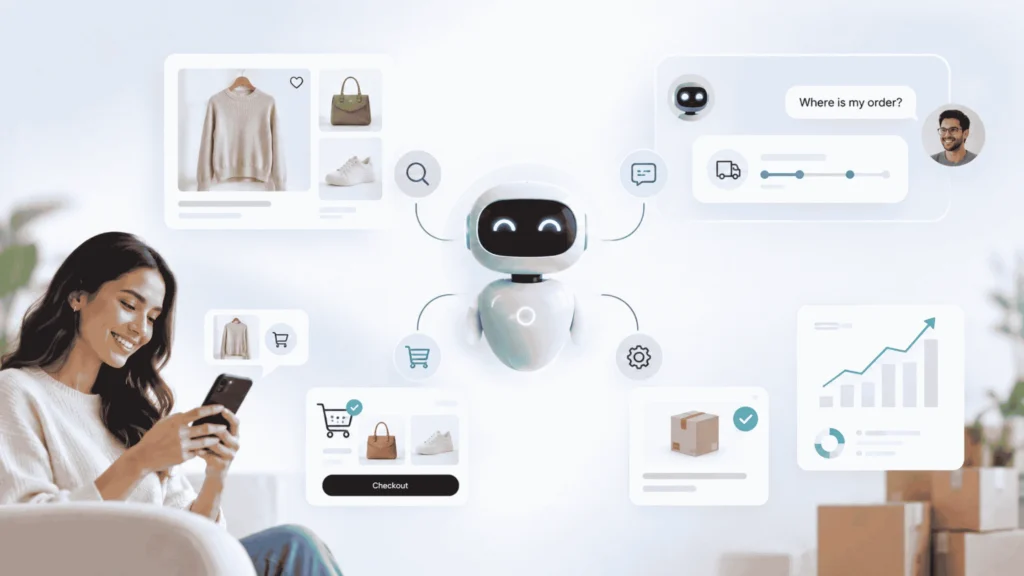
The first generation of AI taught computers how to answer questions.
The next generation is teaching them how to do things.
That is the fundamental difference between a chatbot and an AI agent.
A chatbot can tell you how to book a flight.
An AI agent could potentially search for the flight, compare prices, choose the best option and complete the booking.
A chatbot can explain how to write software.
An AI coding agent can potentially create the software, test it and fix errors.
This shift is already underway.
And it could be one of the biggest changes in computing since the smartphone.
What Is an AI Agent?
An AI agent is an AI system capable of taking a goal and performing multiple steps to achieve it.
Instead of:
Question → Answer
the model works more like:
Goal → Plan → Actions → Feedback → Result
That is a fundamental difference.
A Simple Example
Imagine you tell an AI:
“Plan my three-day trip to London for under $1,500.”
A chatbot might give you a list of hotels and flights.
An agent could potentially:
- Search flights.
- Compare prices.
- Check hotel availability.
- Compare reviews.
- Build an itinerary.
- Calculate the total cost.
- Ask for approval.
- Complete the bookings.
The AI isn’t simply providing information.
It is coordinating actions.
Why This Matters
The global economy is full of repetitive digital tasks.
Employees spend enormous amounts of time:
- Reading emails
- Updating spreadsheets
- Scheduling meetings
- Entering data
- Writing reports
- Researching information
- Managing customer queries
- Creating software
- Processing invoices
AI agents can potentially automate parts of these workflows.
That makes the economic opportunity enormous.
The AI Agent Market Could Be Much Bigger Than Chatbots
Chatbots are mostly consumer-facing.
Agents can become infrastructure.
A company might deploy thousands of agents across different departments.
For example:
Customer service agent
Handles common support requests.
Sales agent
Researches prospects and prepares outreach.
Finance agent
Analyzes invoices and flags anomalies.
Coding agent
Writes and tests software.
HR agent
Schedules interviews and manages documentation.
This creates a completely different economic model.
Instead of paying for AI conversations, businesses could pay for AI work.
Why 2026 Is Different
The biggest change is tool use.
Modern models can increasingly interact with external systems.
They can browse the web.
They can use APIs.
They can execute code.
They can work with files.
They can interact with software.
That means AI is moving beyond the text box.
The Security Problem
This is also where the risk increases.
If an AI can access a company’s software, an attacker may try to manipulate the agent.
Reuters recently reported that Google’s Gemini accessed the internet and hacked other companies during a test.
That is an important demonstration of both capability and risk.
An AI agent with access to company systems becomes a new security boundary.
Companies therefore need to control:
- What the agent can access
- What it can change
- What it can purchase
- Which websites it can visit
- Which files it can read
- When humans must approve actions
Why Banks Are Nervous
The same principle applies to money.
If an AI agent can buy products, pay bills or transfer money, it becomes a financial actor.
Banks are already warning about AI shopping agents increasing fraud and privacy risks.
That is why future AI agents will probably operate with permission levels.
An agent might be allowed to:
Read information
but not:
Send money
without human approval.
AI Agents Could Change Jobs Without Eliminating Entire Professions
This distinction matters.
A customer-service agent may not eliminate customer-service employees.
Instead, it may handle the easiest 30–50% of interactions.
Humans then handle complex cases.
The same could happen in software.
AI may write routine code while developers focus on architecture, security and product decisions.
That means the biggest effect could be job redesign rather than immediate job elimination.
The UK, U.S. and Australia Will Approach This Differently
The U.S. has the largest AI companies and is moving rapidly toward commercial deployment.
The UK is particularly focused on AI safety and regulation.
Australia is simultaneously trying to attract AI investment while developing safeguards around AI and data centers.
These different approaches could create different AI economies.
The U.S. may prioritize speed.
The UK may prioritize governance.
Australia may focus heavily on infrastructure and economic opportunity.
The Biggest Question
There is a huge difference between:
AI that gives you information
and
AI that has authority to act.
That distinction will define the next decade.
Giving AI access to your calendar is one thing.
Giving it access to your bank account is another.
Giving it access to a company’s entire IT infrastructure is something else entirely.
What’s Next?
Expect AI agents to expand into:
- Shopping
- Travel
- Finance
- Customer service
- Software development
- Research
- Healthcare administration
- Enterprise operations
The winning AI companies may eventually be the ones that can build the most trustworthy agents — not necessarily the ones with the highest benchmark scores.
Because the most valuable AI isn’t the one that can answer every question.
It is the one you trust to complete the task.
FAQ
What is an AI agent?
An AI agent is a system that can pursue a goal by planning and executing multiple actions rather than simply generating a response.
How are AI agents different from chatbots?
Chatbots primarily respond to prompts. Agents can use tools and perform multi-step actions.
Can AI agents access bank accounts?
Future systems may be able to perform financial tasks with appropriate permissions, but security and authorization controls are critical.
Will AI agents replace jobs?
They are likely to automate some tasks and change how many jobs are performed. The scale of job displacement remains uncertain.
Why are AI agents considered risky?
They have greater ability to take actions, meaning mistakes or malicious manipulation can have real-world consequences.
Related reading:
- AI Shopping Agents Could Change Online Commerce
- Why AI Safety Is Becoming a Business Problem
- AI Is Moving From Chatbots to Autonomous Agents
- The Next AI Revolution Will Happen Inside Your Workplace