Imagine telling your AI assistant:
“Find me the best 55-inch TV under $1,000, check the reviews, compare five stores and buy it.”
You don’t search.
You don’t open Amazon.
You don’t compare prices manually.
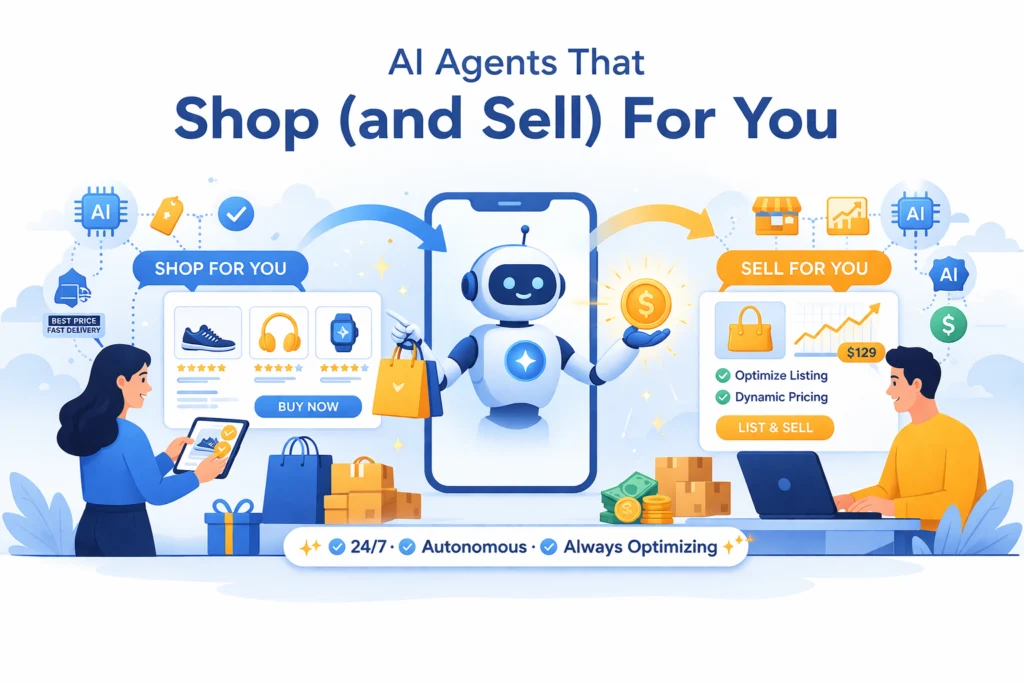
The AI does everything.
That future is arriving quickly.
But banks are already warning that AI shopping agents could create a new generation of fraud, scams and privacy problems.
That creates one of the biggest technology questions of 2026:
What happens when AI doesn’t just recommend what you buy — but actually buys it for you?
Why It Matters
Online shopping has traditionally worked like this:
Human searches → human compares → human clicks → human pays.
AI agents could change that to:
Human gives instruction → AI searches → AI compares → AI purchases.
That sounds convenient.
But it removes humans from several critical security decisions.
And that creates opportunities for attackers.
The New Attack Surface
Banks including NatWest and others are warning about risks associated with AI shopping agents.
The concerns include:
- Fraud
- Fake websites
- Malicious product listings
- Data theft
- Payment manipulation
- Privacy breaches
- Fake discounts
- AI-generated reviews
The problem is that AI agents can process information much faster than humans.
That is their strength.
It can also become their weakness.
Imagine the Following
You ask an AI agent to find cheap airline tickets.
The agent finds what appears to be the best deal.
But the website is fraudulent.
A human might notice that the domain looks suspicious.
An AI agent could potentially complete the transaction before the user realizes what happened.
That is why financial institutions are starting to think about AI agents as a new fraud category.
The Scale Could Become Huge
The global e-commerce market is worth trillions of dollars.
Even if AI agents handle only a small percentage of transactions, the financial implications could be enormous.
Suppose AI agents eventually influence just 10% of online purchases.
That would represent hundreds of billions of dollars in transactions.
The companies controlling those agents could become extremely powerful.
And that is why Google, OpenAI, Microsoft, Amazon, Meta and other technology companies are all interested in agentic commerce.
The Biggest Change: AI Becomes the Buyer
Today’s AI recommends products.
Tomorrow’s AI may purchase them.
That distinction matters.
A recommendation engine has limited responsibility.
An autonomous purchasing agent has much more.
It has to decide:
- Which seller?
- Which product?
- Which price?
- Which shipping option?
- Which payment method?
- Is the seller legitimate?
- Is the discount real?
- Is the product authentic?
Those are financial decisions.
Who Is Responsible When Something Goes Wrong?
This could become one of the biggest legal and regulatory questions.
Imagine:
An AI agent purchases a $2,000 laptop.
The website is fraudulent.
Who is responsible?
The bank?
The AI company?
The retailer?
The user?
The payment processor?
The answer isn’t obvious.
And different countries could establish different rules.
The UK Has a Particularly Interesting Position
The UK has a large online-shopping economy and a highly developed financial-services sector.
That means British banks have strong incentives to prevent AI-driven fraud before autonomous commerce becomes mainstream.
The UK may also become an important testing ground for rules governing AI agents and consumer protection.
Australia Has Another Advantage — and Another Problem
Australia’s large online consumer economy and concentrated banking sector make it another important market for AI commerce.
But geographic distance means Australians already rely heavily on digital commerce.
If AI agents can reduce shopping friction, the technology could become particularly attractive.
At the same time, Australians are exposed to scams and fraudulent websites like consumers everywhere else.
The AI Shopping Revolution Could Help Retailers Too
This isn’t necessarily bad news for businesses.
AI agents could create enormous efficiencies.
Instead of spending millions on advertising, retailers could compete directly on:
- Price
- Reviews
- Product quality
- Delivery
- Reliability
The AI agent could become the new gatekeeper.
That would completely change digital marketing.
Today companies optimize websites for Google.
Tomorrow they may need to optimize product data for AI agents.
SEO Could Change Forever
This has enormous implications for publishers too.
Traditional search asks:
Which websites should appear?
Agentic search asks:
Which products should I buy?
That changes the value chain.
The AI becomes the intermediary.
Retailers may therefore begin optimizing for AI systems rather than humans.
That could create a new industry:
Agent Optimization.
What’s Next?
The next phase of AI commerce will likely involve stronger controls.
Users may be able to specify:
- Maximum spending limits
- Approved retailers
- Approved payment methods
- Categories AI cannot purchase
- Human approval thresholds
For example:
Under $100: AI can buy automatically.
$100–$500: AI asks for confirmation.
Above $500: Human approval required.
That kind of system could make autonomous commerce safer.
The Bigger Question
The biggest change in online shopping may not be that AI makes recommendations better.
It may be that humans stop shopping directly.
Instead, people describe what they want.
The AI does the research.
The AI compares products.
The AI negotiates.
The AI buys.
That could save consumers enormous amounts of time.
But it also means consumers will have to trust AI with something they currently control themselves:
their money.
And that may be the hardest trust problem AI has faced yet.
FAQ
What are AI shopping agents?
AI shopping agents are systems capable of researching products, comparing options and potentially completing purchases on behalf of users.
Why are banks worried?
Banks are concerned about scams, fraud, malicious websites and privacy problems if AI agents begin making financial transactions automatically.
Could AI replace Google Shopping?
AI agents could reduce the need for consumers to browse shopping websites themselves, but search engines and retailers will likely remain part of the underlying infrastructure.
Could AI agents make purchases without permission?
Future systems may allow autonomous purchases within spending limits set by the user, although exact controls will vary by platform.
Will AI agents change online advertising?
Potentially. Retailers may increasingly optimize product information for AI systems rather than relying only on traditional search-engine rankings.
Related reading:
- AI Agents Are Coming for Your Office
- Why Google Is Racing to Build AI Agents
- The Next Internet Battle Is About AI Search
- How AI Could Change Online Shopping Forever