For the past few years, the artificial intelligence race has largely been about one question: which company can build the smartest chatbot?
That question is becoming less important on its own.
The next battle is about something much bigger: which AI assistant will become the technology people rely on to manage their everyday lives.
Imagine an assistant that understands your calendar, summarises important emails, helps you shop, controls your home, prepares travel plans and completes tasks across different applications. Instead of opening ten different apps, you could simply explain what you want and let an AI system coordinate the steps.
This is the direction consumer technology is moving towards. And it is putting some of the world’s biggest technology companies in direct competition.
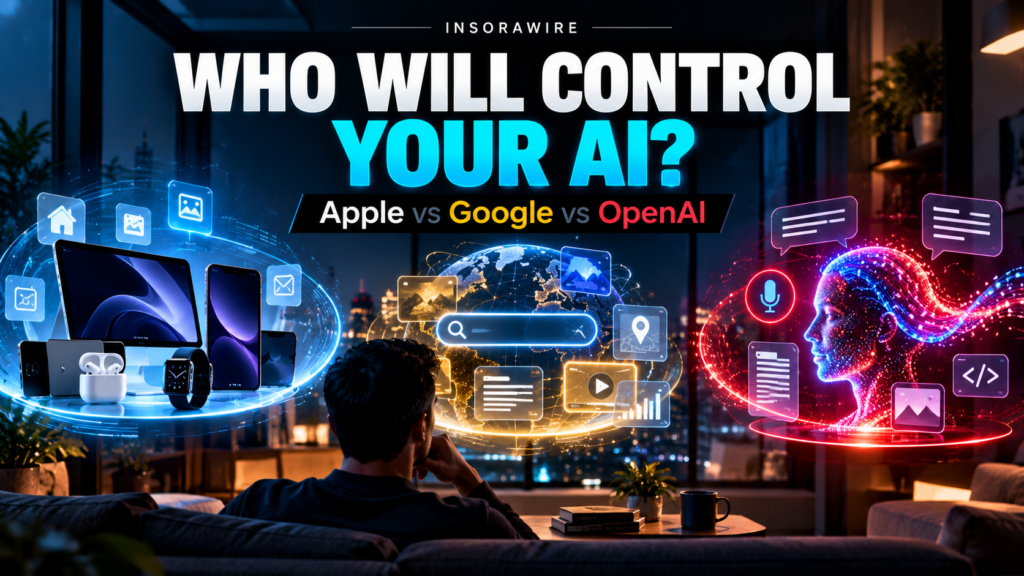
Apple is pushing its AI deeper into devices and the connected home. Google is combining Gemini with its search, Android and cloud ecosystems. OpenAI is working to expand ChatGPT beyond conversations and into more capable assistants and new device experiences.
The stakes are enormous. The company that becomes your default AI assistant could influence how you search for information, which products you discover, which services you use and how you interact with the digital world.
The next AI winner may not simply be the company with the smartest model. It may be the company that becomes the most useful—and trusted—part of your daily life.
Why the AI Race Is Moving Beyond Chatbots
Traditional chatbots are designed primarily to respond to questions and generate content. They can explain concepts, write emails, summarise documents and help users solve problems.
AI agents aim to go further.
An agent can potentially break a request into smaller tasks, use connected tools, retrieve information, interact with supported services and carry out a workflow with less step-by-step guidance from the user.
For example, a conventional chatbot might suggest an itinerary for a weekend trip. A more capable agent could potentially compare flights, check hotel options, organise the schedule and prepare a booking for your approval.
The difference is not that chatbots are becoming obsolete. It is that AI systems are increasingly being designed to move from providing answers to helping complete tasks.
That transition could change how people use software.
Instead of navigating menus, searching websites and moving information between applications, users may increasingly express their goals in natural language. The assistant would then coordinate the underlying actions.
However, there is an important limitation: completing a task reliably is much harder than describing how to complete it. Agents can make mistakes, misunderstand instructions, encounter incompatible services or take actions that require additional permission.
The technology is advancing, but a dependable digital assistant still needs good integrations, clear permissions and effective safeguards.
Apple: The Strategy Is to Put AI Everywhere You Already Live
Apple has a significant advantage that many AI companies would like to replicate: its ecosystem of devices and services.
Millions of people already use iPhones, Macs, Apple Watches, AirPods and connected home products. An AI assistant that works smoothly across these devices could become a natural extension of the products customers already own.
In October 2026, Apple expanded this strategy with the introduction of HomeView, a smart-home display built around a more personalised version of Siri. The device is designed to bring household information and controls into a shared home interface.
According to Reuters, HomeView uses personal context to tailor interactions and is designed to work with compatible smart-home products. Apple has emphasised privacy as part of its approach, including local processing for some functions.
Source: Reuters — Apple’s HomeView brings personalised Siri to the smart home.
Why Apple’s ecosystem matters
Apple does not necessarily need to convince every customer to download a separate AI application. Its opportunity is to make AI useful within the products people already use every day.
A capable assistant could help users find information from supported applications, organise reminders, interact with compatible devices and carry out actions across the ecosystem.
The strategic advantage is convenience. If an assistant already understands the device, operating system and available applications, it may be easier for users to adopt than a standalone tool that requires additional setup.
But Apple’s challenge is equally clear.
Users will expect Siri to be accurate, fast and genuinely helpful. If an assistant repeatedly misunderstands requests or fails to complete tasks, deep integration will not be enough.
Apple must also demonstrate that its privacy commitments can coexist with personalised AI. The more useful an assistant becomes, the more sensitive information it may be asked to handle.
Google: Gemini Could Become the Intelligence Layer Across the Internet
Google’s advantage is different.
The company has a vast ecosystem spanning Search, Android, Gmail, Maps, YouTube, Chrome, Workspace and cloud services. These products already occupy important parts of people’s digital lives.
Gemini gives Google a way to connect AI capabilities across that ecosystem.
Instead of treating AI as a separate destination, Google can integrate it into products people already use to find information, communicate, work and navigate the world.
That creates several opportunities.
AI-powered search
Search has traditionally presented users with links to websites and other sources. AI-powered search experiences can instead provide synthesised answers, summaries and follow-up assistance.
This may make research easier, but it also raises a major question for publishers: if users receive more answers directly from AI interfaces, will they still visit the websites that create the original information?
For a digital publisher such as InsoraWire, this is an important shift to monitor. Original reporting, useful analysis, clear sourcing and distinctive expertise may become even more important as AI systems change how people discover content.
AI across productivity tools
AI can also help users summarise emails, work with documents, organise information and move between tasks.
The more deeply Gemini connects with supported Google services, the more useful it could become as a general-purpose assistant.
The commercial opportunity is significant because Google can distribute AI through products that people already know. However, the company must balance convenience with accuracy, privacy, security and the risk of users becoming overwhelmed by automated features.
The challenge for Google
Google must ensure that AI-generated answers are reliable and that users can distinguish sourced information from errors or unsupported claims.
It also needs to maintain user trust as AI becomes more deeply integrated into products that handle personal information, communications and business data.
Google’s distribution is a powerful advantage, but distribution alone does not guarantee that users will prefer its assistant.
OpenAI: From ChatGPT to a Personal AI Assistant
OpenAI helped bring generative AI into mainstream use through ChatGPT. Its next challenge is to make that experience useful beyond the conversation window.
The opportunity is to turn a general-purpose AI system into an assistant that can help people complete real tasks.
In September 2026, Axios reported that the consumer AI-agent market was becoming increasingly competitive, with companies exploring assistants that can manage activities such as shopping, calls, calendars and online tasks.
Source: Axios — The era of the personal agent has finally arrived.
For OpenAI, this represents a natural extension of ChatGPT’s existing role as a place where users ask questions, create content and solve problems.
A more capable assistant could help a user research a purchase, compare alternatives, prepare a schedule or carry out a multi-step workflow through connected tools.
But moving from a helpful chatbot to a trusted agent creates new challenges.
Reliability becomes more important
A chatbot that produces an imperfect summary may inconvenience the user. An agent that sends the wrong message, changes a calendar incorrectly or submits a transaction without proper approval could cause more serious problems.
OpenAI and other developers therefore need to focus not only on intelligence but also on predictable behaviour, permission controls and the ability to recover from mistakes.
Access to applications matters
An assistant becomes more useful when it can work with the tools people already use.
That requires integrations, permissions and reliable connections to external services. The quality of those integrations may matter as much as the underlying model’s performance.
Trust is the foundation
Users may eventually give AI agents access to email, documents, schedules and other sensitive information. That creates a responsibility to explain what information is accessed, how it is used and what actions the agent can take.
OpenAI’s opportunity is to build on the familiarity of ChatGPT. Its challenge is to prove that a powerful conversational product can also become a dependable digital operator.
Apple vs Google vs OpenAI: Who Has the Advantage?
Each company approaches the market from a different starting point.
| Company | Core adva