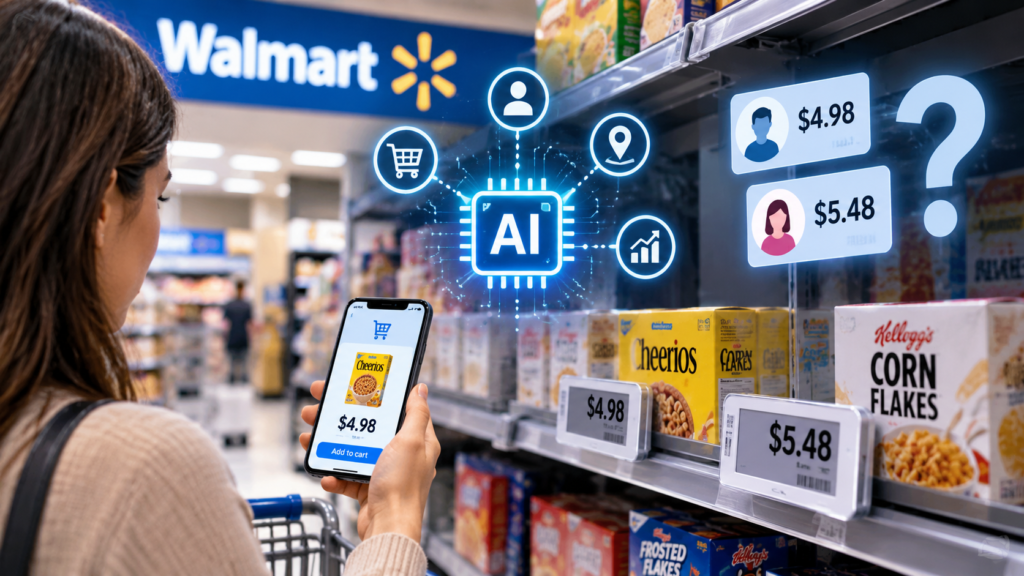
Artificial intelligence is changing how retailers manage inventory, study shopping patterns and decide when to adjust prices. But as more US stores adopt digital price tags and AI-powered shopping tools, consumers are asking an important question: could a retailer use personal data to charge one shopper more than another for the same product?
The concern is growing as retailers expand electronic shelf labels and experiment with new pricing technologies. Walmart has said it will not use customers’ personal information to set individualized prices, but the broader debate about AI and personalized pricing continues.
Here’s how AI-driven pricing works, what Walmart has said, and what consumers should know.
What Is AI Dynamic Pricing?
Dynamic pricing is a system in which a business adjusts prices in response to changing conditions.
For example, an online retailer might change a product’s price based on inventory, supplier costs, competitor prices or demand. Airlines and hotels have long used different prices for different booking conditions.
AI can help businesses analyze large amounts of data, identify patterns and make pricing decisions more quickly.
However, dynamic pricing is not the same as personalized pricing. Understanding the difference is essential to the current debate.
Dynamic pricing
Prices change according to market conditions, such as supply, demand, stock levels or operating costs.
A retailer might lower the price of seasonal products to clear inventory or adjust prices after supplier costs change.
Personalized pricing
A business uses information about an individual consumer to determine what price that person may be willing to pay.
Depending on the system, that could involve analyzing personal data or estimating a customer’s willingness to spend.
Personalized pricing raises different questions about privacy, transparency and fairness because two customers could potentially see different prices for the same product under comparable conditions.
Is Walmart Using AI to Charge Different Customers Different Prices?
Walmart has publicly said it will not use customers’ personal information, such as income or shopping history, to set individualized prices.
The company has also said its AI shopping assistant, Sparky, will not raise prices or conceal suitable lower-cost options.
The statements came amid growing consumer concern about Walmart’s expansion of electronic shelf labels and other retailers’ use of pricing technology.
According to an Associated Press report published in October 2026, Walmart said digital shelf labels are intended to improve price accuracy and save employees time. The company also said it would not charge different prices based on a shopper’s identity or the time of day.
These statements are important because the presence of digital price tags does not, by itself, prove that a store is using personalized pricing.
Electronic labels make it easier to update displayed prices centrally. Whether a retailer actually uses those capabilities to charge different people different amounts is a separate question.
Read the Associated Press report on Walmart’s position.
How Do Electronic Shelf Labels Work?
Traditional paper labels require employees to print and replace price tags when prices change.
Electronic shelf labels display prices digitally and can be updated through a retailer’s systems.
Retailers can use this technology to:
- Update prices more efficiently.
- Reduce errors between shelf labels and checkout systems.
- Apply scheduled discounts.
- Manage promotions across many locations.
- Reduce the labor involved in changing paper labels.
The technology can make price changes easier, but it does not determine why a retailer changes a price.
A store could use electronic labels to display the same price to everyone while updating it centrally. A retailer could also potentially use digital infrastructure to support more sophisticated pricing systems, depending on its policies and technology.
That distinction is why the debate is about both the technology and the rules governing its use.
Why Are Consumers Worried About Personalized Pricing?
The concern is that companies could use personal information to estimate how much an individual is willing to pay.
Imagine two shoppers looking at the same product online. If a retailer used personal data to estimate that one shopper was less price-sensitive than the other, it could theoretically offer them different prices.
That is an illustrative example, not evidence that Walmart is doing this.
Consumers may worry about several issues:
Privacy: What information is collected, and how is it used?
Fairness: Could people with fewer alternatives end up paying more?
Transparency: Would shoppers know that their prices were personalized?
Trust: Could consumers feel that retailers are exploiting their personal circumstances?
These questions become more important as AI systems become better at analyzing behavior and predicting purchasing decisions.
What Is the FTC Doing About Personalized Pricing?
The US Federal Trade Commission has been examining personalized pricing and the use of consumer data in setting prices.
In August 2026, the FTC sought public comment on a proposed enforcement policy statement concerning personalized pricing. The agency said that undisclosed use of personal data to determine individual prices could raise concerns under laws against unfair or deceptive practices.
The proposal was not a blanket federal ban on every form of personalized pricing. The FTC’s announcement specifically acknowledged that its authority does not allow it to prohibit all personalized pricing in every circumstance.
The issue is therefore not simply whether a company uses AI. It is also whether its practices are deceptive, unfair or otherwise unlawful.
For the latest information, see the FTC’s announcement on personalized pricing.
Could AI Pricing Affect Consumers in the UK and Australia?
The debate is particularly visible in the United States, but the underlying questions are relevant to shoppers elsewhere.
United Kingdom
UK consumers should pay attention to how retailers use personal data, how online prices are presented, and whether promotions or discounts come with conditions.
Consumers should consult current guidance from the UK’s Competition and Markets Authority and Information Commissioner’s Office for applicable consumer-protection and privacy rules.
Australia
Australian shoppers face similar questions as retailers adopt more digital tools. The relevant issues include transparent pricing, consumer guarantees, privacy and whether representations about a price could mislead shoppers.
Consumers should check guidance from the Australian Competition and Consumer Commission and the Office of the Australian Information Commissioner.
The legal position differs by country, so US regulatory developments should not be presented as if they automatically apply in the UK or Australia.
How Can Shoppers Protect Themselves?
Consumers can take a few practical steps when shopping online or in stores.
- Compare prices. Check the same product at multiple retailers before purchasing.
- Review the final checkout price. Make sure discounts, fees and delivery costs are clearly displayed.
- Read promotion terms. Some discounts depend on memberships, coupons or eligibility conditions.
- Review privacy settings. Understand what data shopping apps collect and how it may be used.
- Keep records of unusual discrepancies. Screenshots and receipts can help when asking a retailer to explain a price difference.
Private browsing or a VPN should not be treated as guaranteed ways to avoid personalized pricing. Retailers may use other information, and different prices can have legitimate explanations, such as location, taxes, shipping or promotion eligibility.
Will AI Make Shopping More Expensive?
Not necessarily.
AI could help retailers reduce operational costs, forecast demand more accurately, improve inventory management and identify opportunities for discounts.
But pricing tools could also make it easier to adjust prices rapidly or use consumer data in ways shoppers may not expect.
The outcome depends on how companies implement these systems, how transparent they are, how competition works in the market and what consumer-protection rules apply.
The technology alone does not determine whether shoppers benefit or lose out.
Frequently Asked Questions
Does Walmart use AI to charge different prices to different customers?
Walmart has said it will not use personal information to set individualized prices. The existence of electronic shelf labels does not establish that the retailer is charging different customers different prices.
What is the difference between dynamic pricing and personalized pricing?
Dynamic pricing changes prices in response to market conditions. Personalized pricing uses information about an individual consumer to determine the price they may be willing to pay.
Are electronic shelf labels illegal?
Electronic shelf labels are not inherently illegal. Their use must comply with applicable pricing, consumer-protection and other relevant laws.
Can AI determine how much I am willing to pay?
AI systems can analyze data and estimate consumer preferences. Whether a particular retailer uses such estimates to set individual prices depends on its practices and policies.
Is personalized pricing illegal in the United States?
There is no blanket federal prohibition on every form of personalized pricing. Specific practices may raise legal concerns, particularly where data use is undisclosed or conduct is unfair or deceptive.
Final Thoughts
AI-powered pricing is creating new opportunities for retailers to manage inventory, update prices and understand demand. At the same time, it raises legitimate questions about privacy, fairness and transparency.
Walmart has said it will not use personal information to set individualized prices, and that statement should be distinguished from broader concerns about what pricing technology could enable.
For consumers, the most useful response is to compare prices, understand how personal data is used and follow developments in consumer-protection rules. For retailers, clear pricing policies and transparency will be essential to maintaining customer trust.
Sources: Associated Press on Walmart’s pricing policy, Federal Trade Commission on personalized pricing.