Something unusual is happening in Western labor markets: overall unemployment remains historically low, but young people can’t find work. In the UK, youth joblessness just hit its highest level in over a decade. In the US, teen employment has cratered even as headline unemployment sits near 4%. Economists increasingly point to the same culprit everywhere — AI and automation quietly eating the entry-level jobs young people used to rely on.

Why It Matters
This isn’t an abstract statistic — it’s a live, cross-border crisis affecting an entire generation’s first foothold in the workforce. Whether you’re a parent watching your 20-something struggle to land a first job, a young graduate applying to hundreds of roles with no response, or an employer wondering why entry-level hiring feels broken, this trend is playing out in almost identical ways across the US, UK, and Australia right now — which suggests the cause isn’t a local policy failure, but something structural.

The Details
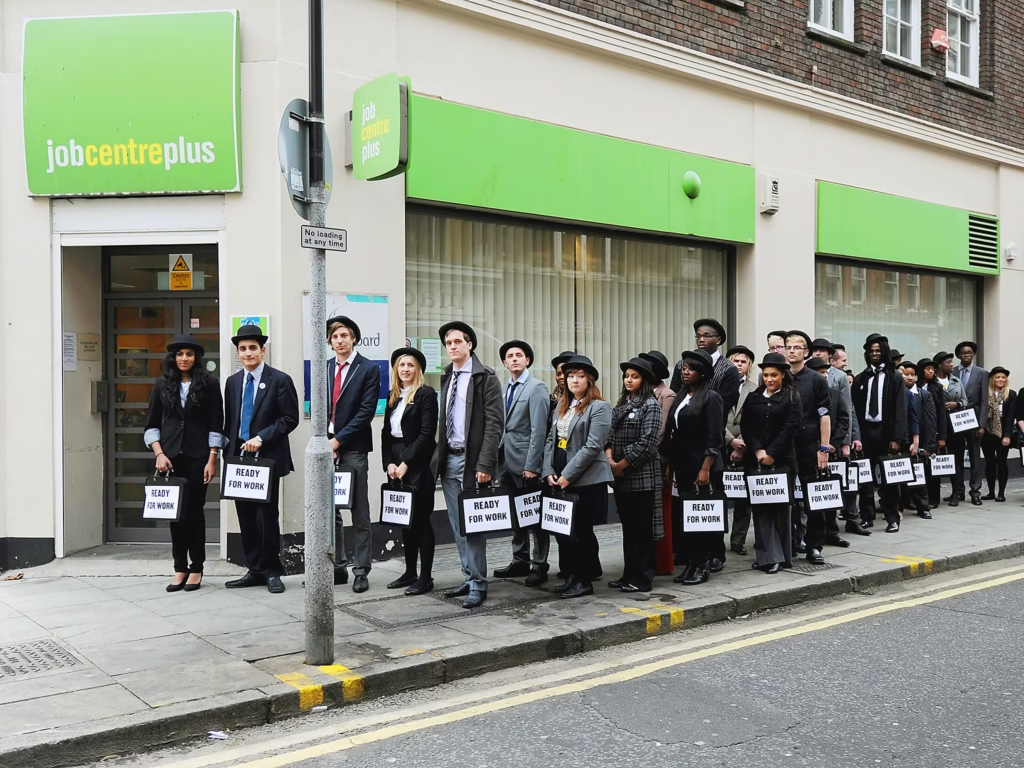
The UK numbers are the starkest. (cite index=”43-1″>The UK’s youth unemployment rate reached 16.4% for the three months to April 2026, up from 14.2% a year earlier, while the number of 16-to-24-year-olds not in education, employment or training (NEET) hit 1.012 million — 89,000 more than the year before and the first time that figure has topped one million since 2013. (cite index=”40-1″>The Resolution Foundation noted that UK youth unemployment has overtaken the EU average for the first time since records began in 2000, and (cite index=”45-1″>the current rate is now higher than it was even during the COVID-19 pandemic. (cite index=”40-1″>Sectors like retail and hospitality have come under particular strain after the government raised employer national insurance contributions, though the scale of the increase points to something bigger than one tax change.
The US picture is arguably more dramatic once you look past the topline number. (cite index=”59-1″>US teen unemployment (ages 16-19) hit 14.6% in June 2026, more than three times the national rate of 4.2%, while teen labor force participation fell to 35.4% from 41.2% a year earlier — a sharp one-year drop. (cite index=”63-1″>Teen employment has been in long-term decline for decades, from a peak of 50.0% in August 1978 down to just 30.7% as of July 2026. This year’s weakness has a specific driver: (cite index=”63-1″>a St. Louis Fed study found that employers substituting AI for young workers, or using it to screen out applicants, accounts for roughly 45% of the decline in the employment-to-population ratio for 18-to-24-year-olds, and about a third of the rise in their unemployment rate, between April 2023 and December 2025. (cite index=”66-1″>A separate Stanford study found that workers aged 22 to 25 in the most AI-exposed occupations saw a 13% decline in employment since 2022, while employment among less-exposed or more experienced workers held steady or even grew.
Australia’s numbers look healthier on paper but reveal the same underlying pattern. (cite index=”49-1″>Australia’s youth unemployment rate stood at 10.4% in July 2026, more than double the national unemployment rate of 4.5%. (cite index=”56-1″>A deeper analysis notes this persistence is a paradox: it’s occurring during a period of historically high overall employment, with total hours worked reaching a record high in December 2025 and the prime-age employment rate near record levels — yet youth joblessness stays stubbornly more than double the national figure, and the broader youth underutilisation measure, which adds in underemployment, runs as high as 25-30% in some monthly estimates.
What This Means for a Generation Entering the Workforce
The pattern across all three countries is consistent enough to be more than coincidence: strong headline employment for adults, sharply weaker outcomes for the youngest workers, and a growing body of research tying the gap to AI adoption specifically in entry-level and customer-facing roles. (cite index=”59-1″>The logic is straightforward — teens and new graduates are typically the last hired and first affected when employers can automate routine, entry-level work such as order processing, cashier duties, or basic screening tasks. That’s a structural shift, not a cyclical dip: it doesn’t reverse just because the broader economy stays strong, because the jobs being automated were never going to come back regardless of GDP growth.
There’s also a self-reinforcing risk buried in these numbers. Entry-level jobs have traditionally been where young workers build the experience, references, and soft skills employers look for later. If AI keeps closing off that first rung, it doesn’t just delay a young person’s career start — it may permanently change what “gaining experience” even looks like for an entire generation, pushing more of that learning into unpaid internships, gig work, or credentialing programs instead of traditional first jobs. Governments have leaned on apprenticeship and training investment as their main policy lever so far, but that approach assumes the jobs on the other side of training still exist in the same numbers they used to — an assumption increasingly worth questioning.
What’s Next
Watch upcoming UK ONS labour market releases and US BLS youth employment reports for whether these trends are accelerating or stabilizing into the autumn hiring season. The UK government’s £1.5 billion youth employment push and expanded apprenticeship targets are worth tracking for early results, as is any comparable policy response building in the US or Australia. Longer term, keep an eye on further Federal Reserve and Stanford-style research quantifying AI’s specific role — if the causal link keeps strengthening, it will shape how policymakers, universities, and employers all rethink what an “entry-level job” even means going forward.
FAQ
Why is youth unemployment rising even though overall unemployment is low? Entry-level, routine, and customer-facing jobs — the kind young people traditionally rely on for their first roles — are being automated or filled by AI tools faster than other types of jobs, while experienced workers in less automatable roles remain in steady demand. This creates a gap where the broader economy looks healthy but young people specifically struggle to find work.
Is AI really the main cause of youth unemployment? Research increasingly points to AI and automation as a significant factor — a St. Louis Fed study attributed roughly 45% of the decline in young worker employment to AI substitution and AI-based hiring screening — but other factors like sector-specific pressures, tax changes affecting employer hiring costs, and population growth in the youth cohort also play a role.
Which country has the worst youth unemployment right now — the US, UK, or Australia? As of mid-2026, the UK has the highest rate among the three at 16.4%, followed by the US teen rate at 14.6% (a narrower 16-19 age band), while Australia’s broader 15-24 measure sits lowest at 10.4% — though Australia’s rate is still more than double its own national unemployment rate, the same underlying pattern seen in the UK and US.