Last Updated: November 11, 2026
Apple could be preparing one of the biggest iPhone design changes since the launch of the iPhone X.
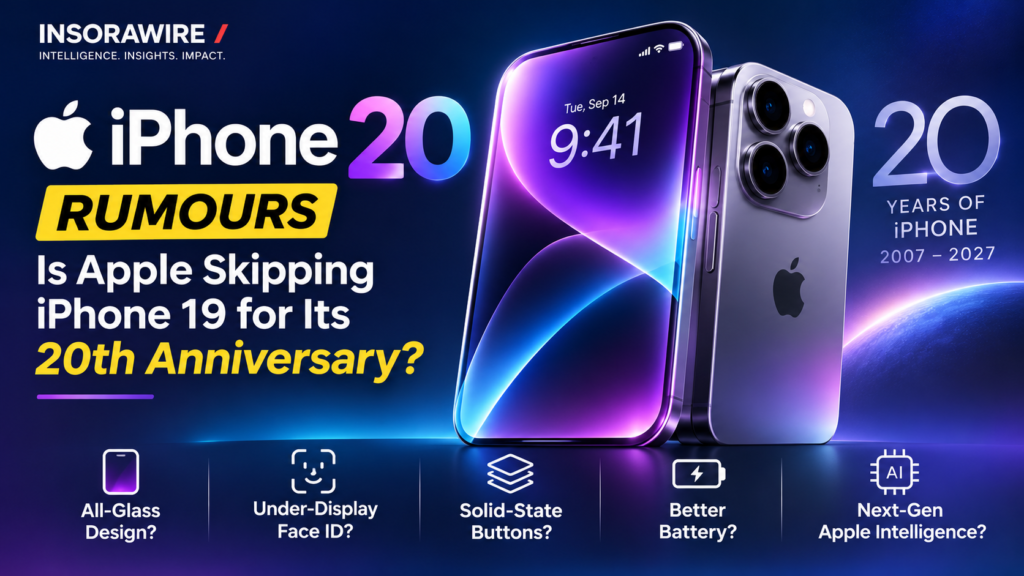
With the original iPhone approaching its 20th anniversary in 2027, reports suggest Apple is working on a completely different design direction for its next premium iPhone lineup.
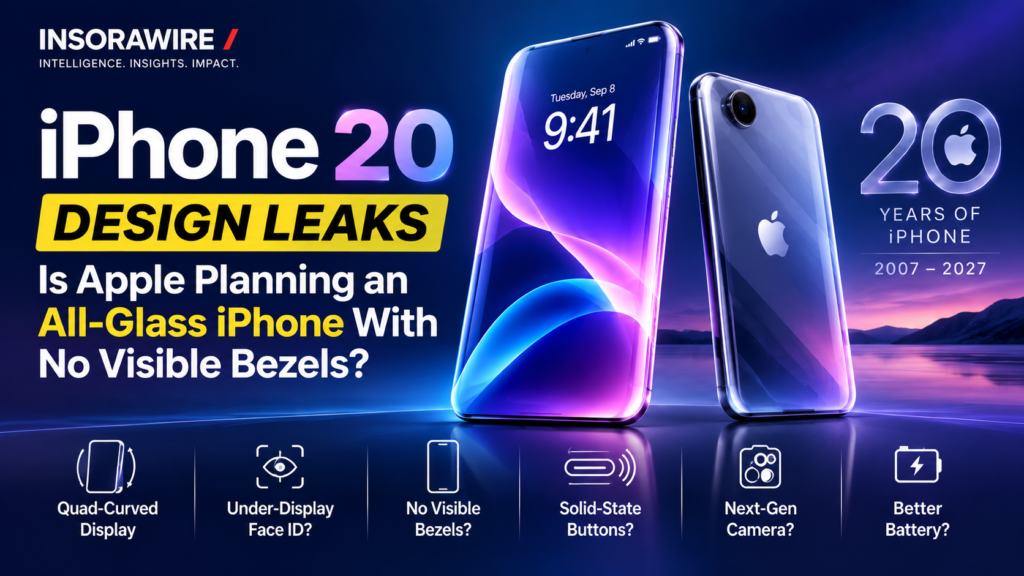
The biggest talking point? A curved-glass design that could make the device look almost like a single piece of glass, with extremely thin bezels and fewer visible interruptions across the display.
Some reports even suggest Apple wants to eliminate the Dynamic Island and move Face ID and the front-facing camera beneath the display.
But there is a catch. Recent leaks suggest that a completely cutout-free display might not be ready in time.
So, what exactly is Apple planning?
Here’s everything we know about the rumoured iPhone 20 design, its display technology, possible changes to Face ID and what users could expect in 2027.
Disclaimer: Apple has not officially announced the iPhone 20 or confirmed its design. All specifications discussed below are based on reports, supply-chain information and leaks available as of November 11, 2026.
1. A Completely New iPhone Design for 2027?
The iPhone’s design has evolved significantly since its introduction in 2007.
The original model featured a physical Home button, a relatively small display and a distinctive aluminium and plastic body.
The iPhone X changed everything in 2017 by removing the Home button and introducing an edge-to-edge OLED display.
Now, Apple could be preparing another major redesign for the iPhone’s 20th anniversary.
According to reporting from The Information, Apple is developing a device with curved glass on both the front and back, extending around all four edges.
The idea is to reduce the appearance of the traditional black frame surrounding smartphone displays.
Rather than looking like a conventional smartphone with a screen attached to a frame, the device could appear more like a continuous glass surface.
If Apple achieves this, it could become one of the most distinctive iPhone designs in years.
2. Quad-Curved Display: What Does It Actually Mean?
One of the most frequently discussed design changes is a quad-curved display.
Most modern iPhones use relatively flat display panels with rounded corners.
A quad-curved design would extend the glass slightly around all four sides of the device.
This could create a more seamless appearance between the front display and the edges.
Unlike some older Android phones with aggressively curved displays, Apple’s reported approach could use much shallower curves.
The possible advantages include:
- A more immersive viewing experience.
- Reduced visual appearance of display borders.
- Smoother transitions between the screen and frame.
- A more premium appearance.
- Improved visual continuity across the front of the device.
Apple is reportedly working with Samsung on display technology for the anniversary iPhone.
However, the exact panel specifications and final design remain unconfirmed.
3. Could the iPhone 20 Finally Have No Visible Bezels?
This is where things become particularly interesting.
Apple has steadily reduced the bezels around its displays over the years.
However, completely removing the visible frame is considerably more complicated than simply using a larger display.
Manufacturers need to accommodate internal components, display connections, sensors and structural elements without compromising durability.
Reports suggest Apple is exploring a design that would conceal more of the device’s metal structure beneath curved glass.
A narrow metal band could still run around the middle of the phone, providing structural support and housing the buttons.
The result could look almost entirely glass from the front.
Whether Apple can achieve a genuinely bezel-free appearance remains uncertain.
4. Will Apple Remove the Dynamic Island?
The Dynamic Island has become a recognisable part of the modern iPhone experience.
It houses front-facing hardware while also displaying notifications, live activities, timers and other interactive information.
However, Apple may eventually want to remove this visible interruption.
For the anniversary iPhone, reports suggest the company has been working on ways to move Face ID components beneath the display.
Some reporting has also suggested that Apple wants to hide the selfie camera.
If successful, this could create a display without a conventional camera cutout.
But the latest information is less certain.
A November 4, 2026 report from 9to5Mac discussed a leak suggesting that the anniversary iPhone could retain display holes for the Dynamic Island rather than offering a completely uninterrupted screen.
This is an important distinction.
Apple could introduce a significantly smaller Dynamic Island without removing it entirely.
For now, three possible outcomes remain:
- A smaller Dynamic Island with more hidden components.
- A small camera cutout with under-display Face ID.
- A completely uninterrupted display with both systems hidden.
The third option would be the most ambitious, but it also faces the biggest technical challenges.
5. Under-Display Face ID: How Could It Work?
Face ID relies on several sensors to recognise a user’s face securely.
Moving these components beneath an OLED display would require the panel to allow the necessary infrared signals to pass through without compromising the recognition system.
This is not a simple engineering challenge.
Apple would need to maintain the speed, accuracy and reliability that users expect from Face ID.
If the technology works as intended, the potential benefits could include:
- Fewer visible sensors.
- More display space.
- A cleaner front design.
- Better integration between the display and front-facing hardware.
However, Apple has not confirmed that under-display Face ID will arrive with the anniversary model.
The technology could also be introduced gradually rather than all at once.
6. Will the iPhone 20 Have a Completely Glass Body?
The phrase all-glass iPhone has attracted considerable attention.
However, it is important to understand what this actually means.
A completely glass enclosure without any supporting frame would present serious challenges around durability, manufacturing and component integration.
Reports indicate Apple has encountered difficulties with its more ambitious glass-only design.
The current direction appears to involve curved glass panels connected by a narrow metal structure.
This would still create a very different appearance from today’s iPhones while maintaining the structural support required for everyday use.
The distinction matters: a glass-centric design does not necessarily mean a phone made entirely of glass.
7. Could Apple Introduce a Larger Display?
The anniversary design could also bring changes to display sizes.
Recent reporting has discussed two possible screen sizes, approximately 6.4 inches and 7 inches.
If these estimates prove accurate, the larger model could offer a particularly immersive viewing experience.
A larger display would be useful for:
- Watching movies and streaming content.
- Playing mobile games.
- Reading and browsing.
- Editing photographs and videos.
- Using productivity applications.
However, these screen sizes are based on rumours, not official specifications.
Apple could change the dimensions before production.
8. Solid-State Buttons Could Complete the New Design
The display may receive most of the attention, but the physical controls could also change.
Reports suggest Apple has been testing solid-state buttons for future iPhones.
Unlike traditional buttons, solid-state controls would not physically move when pressed.
Instead, haptic feedback would simulate the sensation of a click.
This technology could potentially replace some existing controls, including:
- Power button.
- Volume buttons.
- Action button.
- Camera Control.
The benefits could include fewer moving components and greater flexibility in the device’s construction.
Whether Apple will introduce all these changes in the anniversary iPhone remains uncertain.
9. iPhone 20 Design vs iPhone X: Could History Repeat Itself?
The iPhone X was a defining moment for Apple’s smartphone business.
It introduced a new design that influenced almost every iPhone released afterwards.
The anniversary iPhone could attempt something similar.
| Design element | iPhone X (2017) | Expected iPhone 20 (2027) |
|---|---|---|
| Display | Edge-to-edge OLED | Quad-curved OLED possible |
| Bezels | Significantly reduced | Extremely slim possible |
| Front sensors | Notch | Under-display technology possible |
| Face ID | Introduced | Could be hidden beneath display |
| Home button | Removed | Already absent |
| Frame | Stainless steel | Narrower visible metal structure possible |
| Buttons | Physical | Solid-state technology possible |
| Overall design | Major redesign | More glass-centric appearance |
The iPhone X introduced the modern iPhone design language.
The anniversary generation could potentially take that philosophy further.
10. When Could We See the New iPhone Design?
Apple has not confirmed the launch date.
However, the 20th-anniversary iPhone is widely expected to arrive in fall 2027.
September would be a reasonable estimate based on Apple’s traditional iPhone launch schedule.
The company could introduce the new design alongside its premium iPhone lineup.
Until Apple officially announces the product, the exact release date and final design should be treated as unconfirmed.
Final Thoughts: Is Apple Finally Ready to Redesign the iPhone?
The iPhone 20 could represent a significant change in Apple’s design philosophy.
A curved-glass enclosure, slimmer bezels, a redesigned Dynamic Island and potentially hidden Face ID components would make the anniversary generation particularly interesting.
But there is a difference between what Apple is reportedly developing and what will eventually reach consumers.
Some of the most ambitious features could be delayed, scaled back or replaced before the final product launches.
For now, the most interesting development is Apple’s reported move towards a more seamless glass-centric design.
If Apple manages to deliver even part of this vision, 2027 could become another important milestone in iPhone history.
Follow InsoraWire for the latest iPhone 20 design leaks, Apple announcements and technology updates.