Last Updated: November 11, 2026
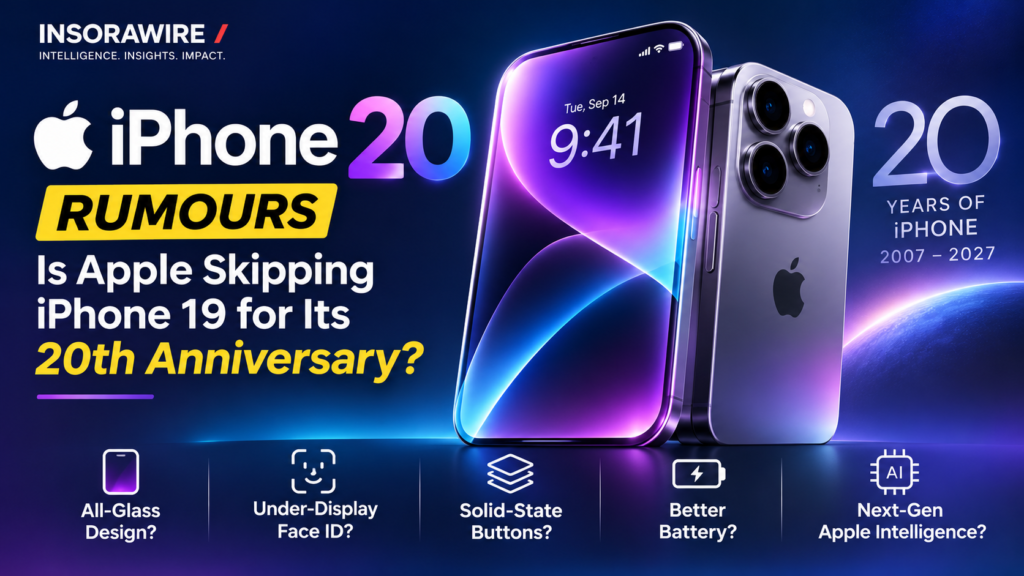
Apple’s 2027 iPhone could be much more than another annual hardware upgrade.
As the company approaches the 20th anniversary of the original iPhone, reports suggest it is working on several major technologies that could change how people interact with their smartphones.
The rumoured iPhone 20, potentially Apple’s anniversary flagship, could introduce a combination of advanced display technology, improved battery performance, new camera sensors and more powerful artificial intelligence capabilities.
But the biggest changes may not be immediately visible.
Imagine unlocking your iPhone without a visible Face ID sensor, pressing buttons that do not physically move, taking photographs with significantly improved dynamic range and using AI features powered by a more advanced processor.
These are some of the technologies reportedly being explored for Apple’s 2027 iPhone.
So, what could actually make it into the final product?
Here is everything we know about the expected iPhone 20 features, based on reports and leaks available as of November 11, 2026.
Important: Apple has not officially announced the iPhone 20 or confirmed its specifications. All features discussed below are expectations, rumours or technologies reportedly under development.
1. Under-Display Face ID: Could Apple Finally Remove the Dynamic Island?
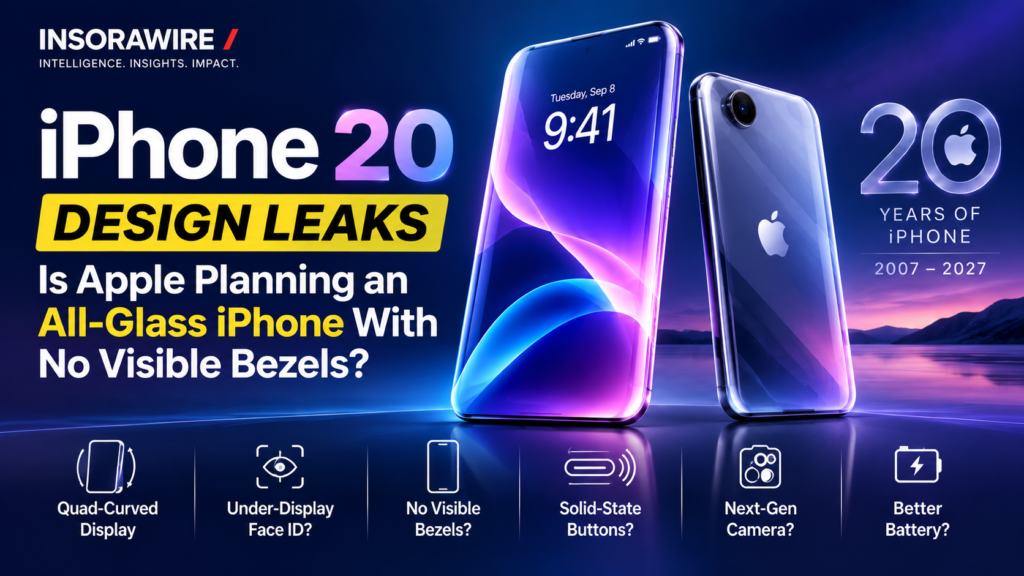
One of the most anticipated changes to the iPhone 20 is the possibility of under-display Face ID.
Since introducing Face ID with the iPhone X in 2017, Apple has continued refining its facial recognition technology.
However, the system still requires several components near the top of the display.
These components contribute to the Dynamic Island, which occupies a small portion of the screen.
For the 20th-anniversary iPhone, Apple could finally move some of this hardware beneath the display.
How would under-display Face ID work?
Under-display Face ID would allow Apple’s facial recognition sensors to operate through specially engineered areas of the OLED panel.
Instead of requiring all the components to remain visible, the display would allow the necessary infrared signals to pass through.
If successful, this could deliver several advantages:
- More usable screen space.
- A cleaner front-facing design.
- Fewer visible display interruptions.
- Better integration between Face ID and the display.
However, there is an important distinction between under-display Face ID and an under-display selfie camera.
Apple could successfully hide some Face ID components while retaining a small camera cutout.
Recent reports have also suggested that the anniversary iPhone could retain a smaller Dynamic Island or punch-hole camera.
Therefore, a completely uninterrupted display is not guaranteed.
2. Solid-State Buttons: Could Physical iPhone Buttons Disappear?
Another interesting rumoured feature is the introduction of solid-state buttons.
Current iPhones use mechanical buttons for power, volume and other controls.
These buttons physically move when pressed.
Solid-state buttons would take a different approach.
Instead of moving mechanically, they would use sensors and haptic feedback to simulate the feeling of a physical press.
Apple already uses similar technology in its MacBook trackpads, where users experience a click without the trackpad physically moving.
What could change with solid-state buttons?
Reports suggest Apple is testing solid-state replacements for several controls:
- Side or power button.
- Volume buttons.
- Action button.
- Camera Control button.
The technology could offer some practical advantages.
Improved durability: Fewer moving mechanical parts could reduce wear over time.
Better water resistance: Reducing physical openings could help Apple improve device protection.
Customisable feedback: Haptic technology could potentially distinguish between different types of presses.
Cleaner design: Buttons could blend more naturally into the curved frame.
There is also an engineering challenge.
The buttons must work reliably with phone cases, gloves, wet hands and extreme temperatures.
Apple has reportedly tested these conditions, although the final implementation remains unconfirmed.
3. A21 Pro Chip: More Power for AI and Everyday Performance
The processor could be another major part of the iPhone 20 upgrade.
Apple’s A-series chips power everything from gaming and photography to machine learning and everyday applications.
For its 2027 flagship, Apple is expected to introduce a successor to the A20 Pro, potentially called the A21 Pro.
The name and specifications have not been confirmed.
What improvements could the next chip deliver?
A newer generation of Apple silicon could focus on several areas:
- Faster CPU performance.
- More powerful GPU processing.
- Improved Neural Engine capabilities.
- Better energy efficiency.
- Faster on-device AI processing.
The anniversary iPhone could also benefit from advances in semiconductor manufacturing.
Apple’s chip manufacturing partner, TSMC, is working on smaller manufacturing processes that could improve performance and efficiency.
However, the exact manufacturing process and performance gains of the potential A21 Pro remain unknown.
The bigger story is not simply speed.
Apple could use the additional processing capabilities to make AI features faster and more useful without relying entirely on cloud computing.
4. Apple Intelligence: Could AI Become the Biggest iPhone Upgrade?
Artificial intelligence is becoming one of the most important areas of competition among smartphone manufacturers.
Google, Samsung and Apple are all investing heavily in AI-powered smartphone experiences.
Apple has already introduced Apple Intelligence, bringing AI-assisted features into several parts of the iPhone experience.
By 2027, the company could take this further.
What could improve with iPhone 20?
Although Apple has not announced any iPhone 20-specific AI features, several areas could see improvements.
A smarter Siri
Users could eventually expect Siri to understand more complicated requests, remember conversational context and perform tasks across multiple applications.
Advanced photo editing
AI could make it easier to remove unwanted objects, improve lighting and edit photographs using natural-language instructions.
On-device AI processing
A more powerful Neural Engine and faster memory could help run certain AI tasks directly on the device.
More personalised experiences
AI could potentially help users organise information, manage notifications and receive more relevant suggestions.
One particularly interesting possibility is Apple’s use of advanced memory technology.
Reports suggest Apple is evaluating Mobile High Bandwidth Memory, or HBM, for future iPhones.
This technology stacks memory components vertically to improve data transfer speeds.
If adapted successfully for smartphones, it could help demanding AI workloads access information more efficiently.
However, HBM adoption in the anniversary iPhone remains speculative.
5. Camera Upgrade: Could Apple Deliver a Major Photography Breakthrough?
The camera is one area where users can immediately notice the difference between smartphone generations.
For the iPhone 20, Apple could focus on improving image sensors and dynamic range.
One of the more interesting rumours involves a custom Sony sensor using LOFIC technology.
LOFIC stands for Lateral Overflow Integration Capacitor.
It is designed to help image sensors capture a wider range of brightness levels.
Why does this matter?
Imagine taking a photograph of someone standing in front of a bright window.
A conventional camera may struggle to preserve detail in both the person’s face and the bright background.
A sensor with improved dynamic range could capture more information from bright and dark areas simultaneously.
Potential benefits include:
- Better photographs in difficult lighting.
- Improved highlight retention.
- More detail in shadows.
- Reduced image noise.
- Better overall photographic flexibility.
This could be particularly useful for people who regularly photograph landscapes, buildings, people and night scenes.
The final sensor specifications remain unknown, and Apple has not confirmed a LOFIC camera for the anniversary iPhone.
6. Silicon-Anode Battery: Could the iPhone 20 Last Longer?
Battery life is one of the biggest everyday concerns for smartphone users.
Even the most advanced smartphone becomes frustrating when it needs to be charged several times throughout the day.
Apple could be exploring a different battery technology for its 2027 iPhone.
Reports suggest the company is investigating silicon-anode batteries.
What is a silicon-anode battery?
Most conventional lithium-ion batteries use graphite-based anodes.
Silicon can store more lithium ions per gram than graphite, which means it has the potential to offer higher energy density.
In simpler terms, manufacturers could potentially fit more energy into a similar amount of physical space.
For the iPhone 20, this could mean:
- Longer battery life.
- More energy storage in a compact battery.
- Better efficiency.
- Greater flexibility when designing internal components.
However, silicon-based battery technology comes with challenges, including expansion during charging and long-term durability.
Apple would need to solve these issues before using the technology in a mass-market smartphone.
It is also important to remember that battery life depends on more than battery capacity. The display, processor, modem and software all play important roles.
7. New OLED Technology: Brighter Displays With Lower Power Consumption?
The iPhone 20 could also receive improvements to its OLED display.
One technology discussed in earlier reports is Color Filter on Encapsulation, commonly called COE.
The technology removes the conventional polarising film and applies the colour filter directly to the display’s encapsulation layer.
Potential advantages include:
- A thinner display structure.
- Improved light transmission.
- Potentially higher brightness.
- Lower display power consumption.
This could be particularly useful if Apple introduces a quad-curved display.
However, there is conflicting supply-chain reporting about the timing of COE adoption. A November 10 report noted that the technology may not be ready for Apple’s 2027 Pro iPhones.
Therefore, COE should be treated as a possibility rather than an expected confirmed feature.
8. Could Apple Introduce Faster Connectivity With a New Modem?
Apple has been developing its own cellular modem technology as part of its effort to reduce reliance on external suppliers.
The anniversary iPhone could introduce another generation of Apple’s modem technology.
A successor to its existing modem, potentially called C3, has been discussed in industry reporting.
A newer modem could potentially improve:
- Cellular connectivity.
- Network efficiency.
- Power consumption.
- Signal management.
- Overall wireless performance.
However, Apple has not confirmed a C3 modem for the iPhone 20.
The actual improvements will depend on the final hardware and network support in different markets.
9. iPhone 20 Expected Specifications: What Could Apple Introduce?
Here is a summary of the technologies reportedly being explored for the anniversary iPhone.
| Feature | Current expectation | Status |
|---|---|---|
| Processor | A21 Pro | Expected, unconfirmed |
| Face ID | Under-display | Rumoured |
| Front camera | Smaller cutout or under-display | Uncertain |
| Buttons | Solid-state haptic | Rumoured |
| Battery | Silicon-anode technology | Under investigation |
| Camera | Custom LOFIC sensor | Rumoured |
| Memory | Possible HBM technology | Under evaluation |
| Display | Quad-curved OLED | Reported |
| Display technology | COE | Timing uncertain |
| Modem | Possible next-generation Apple modem | Speculative |
These are not official specifications. Apple could change its plans before production.
10. iPhone 20 vs iPhone 18 Pro: How Much Could Technology Change?
The iPhone 20 is still some distance away, so a direct specification comparison is not possible.
However, the technologies being discussed suggest that Apple could focus on a more substantial transformation than a routine processor and camera upgrade.
| Technology | iPhone 18 Pro | Expected iPhone 20 |
|---|---|---|
| Display | Modern OLED | More advanced curved OLED possible |
| Face ID | Existing sensor arrangement | Under-display components possible |
| Buttons | Mechanical controls | Haptic solid-state controls possible |
| Processor | A20 Pro | Potential A21 Pro |
| Battery | Conventional battery technology | Silicon-anode technology possible |
| Camera | Existing Pro camera system | Advanced HDR sensor possible |
| AI | Apple Intelligence | Further AI capabilities possible |
| Connectivity | Current-generation modem technology | Newer Apple modem possible |
The biggest difference could be the combination of these technologies rather than any single upgrade.
11. Should You Wait for the iPhone 20?
If you are planning to buy a new iPhone, should you wait until 2027?
The answer depends on your current device.
If you own an iPhone 17 or iPhone 18: You may not need to upgrade immediately. If your phone is working well, waiting for the anniversary generation could give you access to a potentially more substantial redesign.
If you own an iPhone 15 or older: Consider your current battery health, performance and storage requirements. A newer iPhone could already provide meaningful improvements.
If you are planning a premium upgrade: Waiting until Apple reveals its 2027 lineup could be worthwhile if the rumoured hardware changes interest you.
However, do not make a purchase decision based entirely on leaks.
The final iPhone 20 specifications could be different from what current reports suggest.
Frequently Asked Questions
1. What new features will the iPhone 20 have?
Rumoured features include under-display Face ID, solid-state buttons, an advanced OLED display, improved camera sensors, silicon-anode battery technology and a next-generation processor. Apple has not confirmed these specifications.
2. Will the iPhone 20 have under-display Face ID?
Apple is reportedly testing under-display Face ID technology. However, it is unclear whether the technology will be ready for the 2027 launch. A smaller display cutout could remain.
3. Will the iPhone 20 have solid-state buttons?
Reports suggest Apple is testing solid-state buttons with haptic feedback. These could replace traditional mechanical controls, although their inclusion is not confirmed.
4. Will the iPhone 20 have better battery life?
Apple is reportedly exploring silicon-anode battery technology, which could increase energy density. This may allow longer battery life without significantly increasing battery size.
5. What processor will the iPhone 20 use?
The anniversary iPhone is expected to use a successor to the A20 Pro, potentially called the A21 Pro. Apple has not confirmed its name or specifications.
6. Will the iPhone 20 have a better camera?
A custom image sensor using LOFIC technology has been discussed in reports. It could improve dynamic range and preserve more detail in bright and dark areas.
7. Will the iPhone 20 support advanced AI features?
Apple is expected to continue developing Apple Intelligence. A newer processor and potentially faster memory could support more advanced on-device AI capabilities.
8. When will the iPhone 20 launch?
The anniversary iPhone is expected to arrive in fall 2027, potentially around September. Apple has not confirmed a launch date.
Final Thoughts: The iPhone 20 Could Be More Than Just Another Upgrade
The most interesting thing about the iPhone 20 is the possibility that Apple is preparing several technological changes at the same time.
Under-display Face ID, solid-state buttons, improved camera sensors and next-generation battery technology could make the anniversary iPhone significantly different from existing models.
Artificial intelligence could also become a much bigger part of the experience, particularly if Apple introduces faster processors and more advanced memory.
But there is still a long way to go before the final product reaches consumers.
Some technologies may arrive in 2027, while others could be delayed or introduced in later generations.
For now, the iPhone 20 remains one of the most interesting upcoming smartphone projects to follow.
Keep following InsoraWire for the latest Apple, iPhone 20 and technology developments.