Last Updated: November 11, 2026
Apple could be preparing something special for 2027, and it might be one of the biggest changes to the iPhone lineup in years.
The original iPhone changed the smartphone industry when Steve Jobs introduced it in January 2007. Now, as Apple approaches the 20th anniversary of that launch, reports suggest the company could be preparing a major redesign to celebrate the milestone.
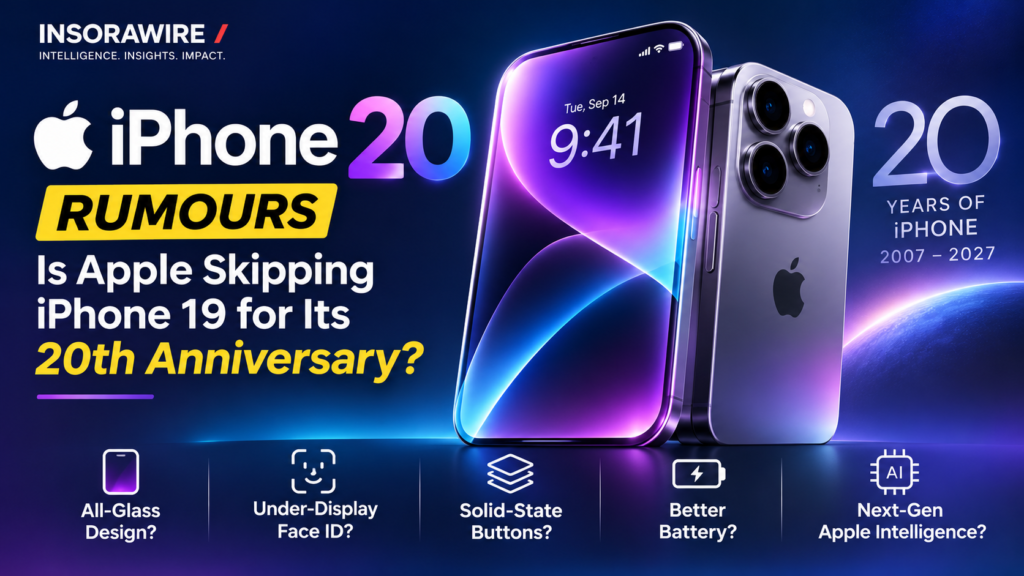
But there is another interesting possibility: Apple might skip the iPhone 19 name entirely and jump straight to the iPhone 20.
It would not be the first time Apple has changed its naming strategy for an anniversary. In 2017, the company introduced the iPhone X instead of following the expected iPhone 9 naming sequence.
Could history repeat itself in 2027?
From a redesigned glass body and an almost bezel-free display to under-display Face ID and new battery technology, here is everything we know about Apple’s rumoured iPhone 20.
Important: Apple has not officially confirmed the iPhone 20 name, its specifications or its launch date. The information below is based on industry reporting, analyst predictions and leaks available as of November 11, 2026.
1. Why Could Apple Skip iPhone 19 and Launch iPhone 20?
The biggest reason behind this rumour is Apple’s 20th anniversary.
The first-generation iPhone was introduced by Steve Jobs on January 9, 2007, and went on sale in the United States on June 29, 2007.
That makes 2027 an important milestone for Apple’s smartphone business.
Some industry reports suggest Apple could skip the iPhone 19 branding and move directly to iPhone 20 to highlight the anniversary.
There is already a historical precedent.
Remember the iPhone X in 2017?
In 2017, Apple celebrated the iPhone’s 10th anniversary by introducing the iPhone X alongside the iPhone 8 and iPhone 8 Plus.
The iPhone X was not just another annual upgrade. It introduced a completely different design philosophy.
Some of its biggest changes included:
- Removal of the traditional Home button.
- Introduction of Face ID.
- An OLED display with much slimmer bezels.
- A new gesture-based navigation system.
- A premium stainless-steel design.
The iPhone X helped define the design language that Apple continued using for several generations.
Apple could follow a similar strategy in 2027.
However, skipping iPhone 19 does not necessarily mean every iPhone launched in 2027 will be called iPhone 20. Apple could retain conventional numbering for some models while introducing special anniversary branding for its premium lineup.
For now, both the naming strategy and product lineup remain unconfirmed.
2. iPhone 20 Could Bring Apple’s Biggest Design Change Since iPhone X
One of the most interesting parts of the iPhone 20 rumours concerns its design.
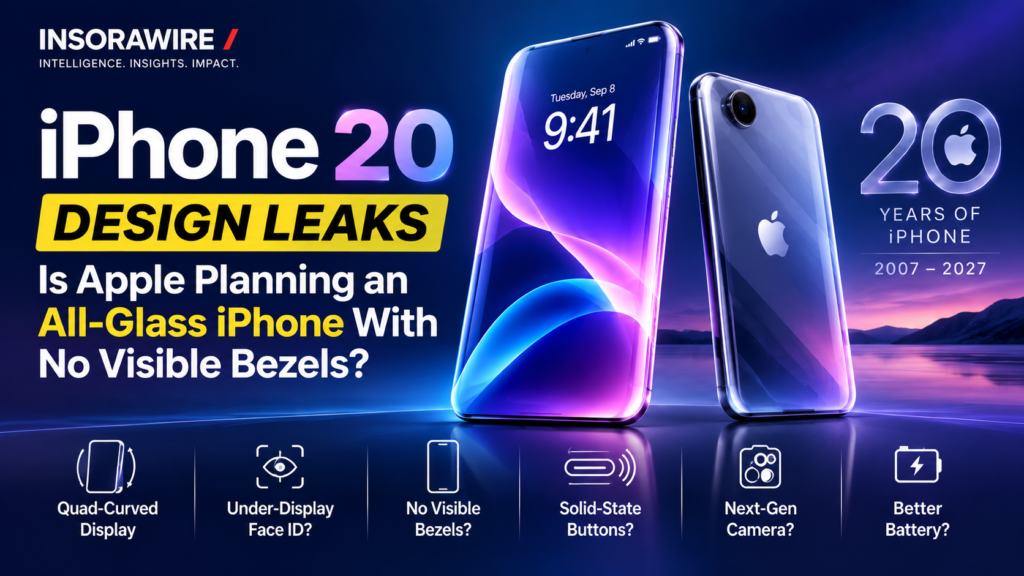
According to recent reporting, Apple is working on a more glass-centric design that could make the next-generation iPhone look significantly different from current models.
The objective appears to be a more immersive display with fewer visible interruptions.
Could Apple introduce a quad-curved display?
One of the reported design changes is a display that curves slightly around all four edges of the device.
Unlike traditional flat displays, a quad-curved panel could create a more seamless appearance between the front glass and the sides.
Reports suggest Apple is working with Samsung on advanced OLED display technology for this design.
The expected benefits could include:
- Thinner-looking display borders.
- A more immersive viewing experience.
- Improved screen-to-body ratio.
- A smoother transition between the display and frame.
However, this does not necessarily mean Apple will introduce a completely glass-only smartphone.
Reports indicate that Apple may retain a metal frame while using curved glass to conceal more of the device’s structure.
Will the iPhone 20 finally remove visible bezels?
This is another possibility worth watching.
Apple has gradually reduced display bezels across successive iPhone generations.
The iPhone X was a major step forward, but the display still included a notch for its front-facing camera and Face ID hardware.
The Dynamic Island later changed how Apple presented these front-facing components.
With the anniversary iPhone, Apple could take another step towards a nearly uninterrupted display.
Whether it can completely eliminate visible cutouts remains uncertain.
3. Could Apple Finally Move Face ID Under the Display?
Face ID has become one of the most recognisable features of modern iPhones.
But the technology requires multiple sensors, and those components occupy space near the top of the display.
Apple could change that with the iPhone 20.
Reports suggest the company is continuing to explore under-display Face ID technology.
If successful, this could allow Apple to move some of the facial recognition hardware beneath the OLED panel.
The result could be a cleaner display with fewer visible components.
However, there is an important complication.
Moving Face ID beneath the display is different from hiding the selfie camera completely.
Apple could introduce under-display Face ID while retaining a small camera cutout.
Some display analysts have also questioned whether the technology will be ready in time for 2027.
Therefore, a completely uninterrupted screen should still be considered speculative.
4. Solid-State Buttons Could Replace Traditional Physical Buttons
Another interesting possibility is the introduction of solid-state buttons.
Current iPhones use physical buttons for power, volume and other controls.
Solid-state buttons would work differently.
Instead of physically moving when pressed, they could use haptic feedback to simulate the sensation of pressing a traditional button.
Think about Apple’s existing trackpads, which use haptic technology to create the feeling of a physical click.
A similar approach on the iPhone could offer several advantages:
- Fewer moving mechanical components.
- Potentially improved durability.
- More consistent button feedback.
- Greater flexibility in device design.
Apple has reportedly been testing this technology for future iPhone models.
However, it remains unclear whether all physical buttons will be replaced in the anniversary generation.
5. Camera Improvements: Could the iPhone 20 Deliver a Major Photography Upgrade?
Apple’s camera improvements have become an important part of its annual iPhone launches.
For the anniversary generation, the company could focus on improving image quality rather than simply increasing camera specifications.
One rumoured area of development involves advanced image sensors.
Reports have discussed the possibility of a custom Sony image sensor using LOFIC technology.
LOFIC stands for Lateral Overflow Integration Capacitor. The technology is designed to improve how image sensors handle a wider range of light levels.
Potential benefits could include:
- Better highlight retention.
- Improved dynamic range.
- More detail in challenging lighting.
- Better-looking photographs in high-contrast scenes.
If Apple adopts this technology, it could be a meaningful improvement for people who regularly use their iPhones for photography and video.
However, the final camera specifications have not been confirmed.
6. Battery Technology Could Be Another Major Upgrade
Battery life remains one of the biggest considerations when buying a smartphone.
A more powerful processor and advanced display technology are useful, but users also want their devices to last throughout the day.
One technology reportedly being explored for future iPhones is the silicon-anode battery.
Traditional lithium-ion batteries use graphite-based anodes. Silicon can potentially store more lithium ions per gram, offering higher energy density.
In practical terms, this could allow manufacturers to increase battery capacity without significantly increasing the physical battery size.
For the iPhone 20, possible benefits could include:
- Longer battery life.
- Better energy efficiency.
- More room for other internal components.
- Improved performance under demanding workloads.
However, battery technology is particularly challenging to commercialise at scale.
Apple has not confirmed that silicon-anode batteries will arrive in its 2027 iPhone lineup.
7. Apple Intelligence Could Become a Bigger Part of the iPhone Experience
Artificial intelligence is becoming a major part of Apple’s product strategy.
With every software generation, Apple has been expanding the role of Apple Intelligence and Siri.
By the time the anniversary iPhone arrives in 2027, users may expect AI to play a much bigger role in everyday smartphone tasks.
Potential areas of development include:
- More advanced Siri conversations.
- Better contextual understanding.
- Smarter interactions across applications.
- Improved photo and video editing.
- More powerful on-device AI processing.
The iPhone 20 could also benefit from more advanced memory technology and a newer processor designed to support demanding AI workloads.
However, Apple has not announced any iPhone 20-specific AI capabilities.
The actual experience will also depend on which features Apple makes available through iOS.
8. iPhone 20 Release Date: When Could Apple Launch It?
Apple has not announced a release date for the iPhone 20.
However, looking at Apple’s traditional iPhone launch schedule, September 2027 is a reasonable expectation.
The original iPhone anniversary falls in June 2027, but Apple does not necessarily need to launch its anniversary model on the exact anniversary date.
The iPhone X, for example, was announced in September 2017.
A possible timeline could look like this:
| Event | Expected timeline |
|---|---|
| Anniversary year | 2027 |
| Product announcement | September 2027 |
| Pre-orders | September 2027 |
| Retail availability | September or October 2027 |
These dates are estimates based on Apple’s historical launch patterns, not confirmed information.
9. How Much Could the iPhone 20 Cost?
Pricing is another big question.
If Apple introduces a major redesign with advanced display technology, new battery components and additional hardware improvements, the anniversary model could occupy a premium price category.
Some industry coverage has speculated that the starting price could reach $1,299 or more for the premium model.
For comparison, the iPhone 17 Pro Max launched in the US at $1,199.
However, there is no confirmed iPhone 20 price, and it is too early to treat any pricing estimate as reliable.
The final cost will depend on the hardware Apple selects, the model lineup and its overall positioning.
10. iPhone 20 vs iPhone X: Could Apple Repeat History?
The iPhone X changed the way people interacted with their smartphones.
Ten years later, Apple could be preparing another major design transition.
| Feature | iPhone X (2017) | Expected iPhone 20 (2027) |
|---|---|---|
| Display | OLED edge-to-edge display | More immersive curved OLED |
| Home button | Removed | Already absent |
| Face ID | Introduced | Could move beneath display |
| Front display cutout | Notch | Smaller cutout or potentially none |
| Buttons | Physical buttons | Solid-state technology possible |
| Design | Glass and stainless steel | More glass-centric design |
| Software | iOS 11 | Expected next-generation iOS |
| Positioning | 10th anniversary model | Potential 20th anniversary model |
The iPhone X introduced a new design direction. The iPhone 20 could potentially refine that approach further.
But whether it becomes equally important to Apple’s product history remains to be seen.
11. Should You Wait for the iPhone 20 or Buy an iPhone Now?
This is probably the most practical question for anyone considering an iPhone upgrade.
If you are currently using an iPhone 16, iPhone 17 or another relatively recent model, waiting for the 2027 lineup could make sense if your device is still performing well.
The anniversary generation could introduce a more substantial design change than a typical annual update.
However, there are reasons not to wait.
If your current smartphone has poor battery health, performance problems or a damaged display, delaying an upgrade for an unannounced product may not be worthwhile.
There is also the possibility that some of the most ambitious iPhone 20 features could be delayed.
Our recommendation is simple: don’t buy a new iPhone purely because of rumours, but don’t postpone a necessary upgrade either.
Wait for Apple’s official announcement before making a decision based on unconfirmed features.
Frequently Asked Questions About iPhone 20
Will Apple skip iPhone 19 and launch iPhone 20?
Apple could skip the iPhone 19 name to celebrate its 20th anniversary in 2027. Industry reports have discussed this possibility, but Apple has not confirmed its naming strategy.
Why is Apple considering an iPhone 20?
The original iPhone launched in 2007, making 2027 its 20th anniversary. Apple could use this milestone to introduce a major redesign, similar to the iPhone X in 2017.
When will the iPhone 20 be released?
The iPhone 20 is expected by some industry reports to arrive in September 2027. Apple has not announced an official launch date.
Will the iPhone 20 have an all-glass design?
Reports suggest Apple is developing a more glass-centric design with quad-curved display edges. However, a completely all-glass device has not been confirmed, and a metal frame may remain.
Will the iPhone 20 have an under-display camera?
Apple is reportedly exploring under-display camera and Face ID technology. However, the final design remains uncertain, and a small display cutout could still be present.
Will the iPhone 20 have solid-state buttons?
Some reports suggest Apple is testing solid-state haptic buttons that could replace traditional physical controls. Their inclusion in the final product is not confirmed.
How much will the iPhone 20 cost?
There is no official price. Some estimates suggest that a premium anniversary model could cost $1,299 or more in the United States, but this remains speculation.
Is the iPhone 20 worth waiting for?
If your current iPhone is working well, waiting for the expected 2027 launch could be worthwhile. However, users who need a new phone should not delay an essential purchase based only on rumours.
Final Verdict: Could 2027 Be the Biggest Year for the iPhone Since 2017?
Apple’s 20th anniversary presents an interesting opportunity.
The iPhone X changed the company’s smartphone design philosophy in 2017. Now, ten years later, Apple could be preparing another major transformation.
A more immersive curved display, under-display Face ID, solid-state buttons and improved battery technology could make the anniversary generation particularly interesting.
But the biggest question remains unanswered: will Apple actually skip iPhone 19 and move directly to iPhone 20?
Until Apple makes an official announcement, that remains a possibility rather than a confirmed decision.
One thing is certain: 2027 could be an important year for the iPhone, and we’ll be following every significant development.
Keep following InsoraWire for the latest Apple, iPhone and technology updates.